Three ways to redact identifiers, and the site approves every redaction
Version 2.2 · Updated 16 October 2026
Source documents carry names, dates of birth and record numbers that a study does not need. The site chooses where they come off, before or after upload.
Site redaction tool
Before upload. The site redacts with a tool it already has, such as Adobe Acrobat Pro.
In the browser Coming soon
Before upload. The Castor Catalyst redaction engine runs on the site's own computer. The original never leaves the device.
Castor redacts
After upload. The engine redacts typed and printed identifiers in the Catalyst Source Gateway, in the site's country.
No large language models in redaction
The redaction engine finds identifiers with rules and small purpose-built recognisers trained only on synthetic documents; no large language models and no external services.
The site approves every redaction
No document goes to the Catalyst pipeline until the site approves the redactions, in every path, also when Castor's engine redacted.
Catalyst Source Gateway
No large language models · No other subprocessors
Study-isolated, encrypted, in the site's country.
How each path works, step by step
Paths A and B redact at the site before upload. Path C redacts in the Catalyst Source Gateway straight after upload. Every path ends with the site approving the redactions.
-
Site redaction tool
Before uploadThe site can redact any of its own source documents, for example in Adobe Acrobat Pro.1
1. Work on a copy, never on the source the site keeps. 2. Redact the identifiers with "Sanitize and remove hidden information" switched on. 3. Check every page.
Redaction needs Acrobat Pro; Acrobat Reader cannot redact.
The site uploads the redacted copy to the pseudonymised participant ID and approves it for submission.
-
In the browser
Coming soonBefore uploadThe Castor Catalyst redaction engine runs on the site's own computer. The original never leaves the device. Same engine as path C.
1. Load the engine once. IT can run a built-in browser check and a self-test without patient data. 2. Redact in the browser. Nothing is uploaded yet.
The site checks and approves the redactions, then uploads the redacted copy. The original stays at the site.
-
Castor redacts
After uploadNo large language models · No other subprocessorsThe site redacts any handwritten identifiers itself, then uploads; the engine redacts the typed and printed identifiers in the Catalyst Source Gateway, in the site's country.
1. Upload to the pseudonymised participant ID. 2. Identifiers are redacted from a list based on the Safe Harbor method of the US Health Insurance Portability and Accountability Act (HIPAA).2
For French sites, Castor redacts (C) only once health data hosting (HDS) is confirmed for the study.
The site checks and approves the redactions before the document is submitted.
Identity comes off. The clinical story stays.
The same aim on every page, in every path: redact the identifiers and keep the clinical content readable. The site checks every page before it approves.
Redacted everywhere it appears
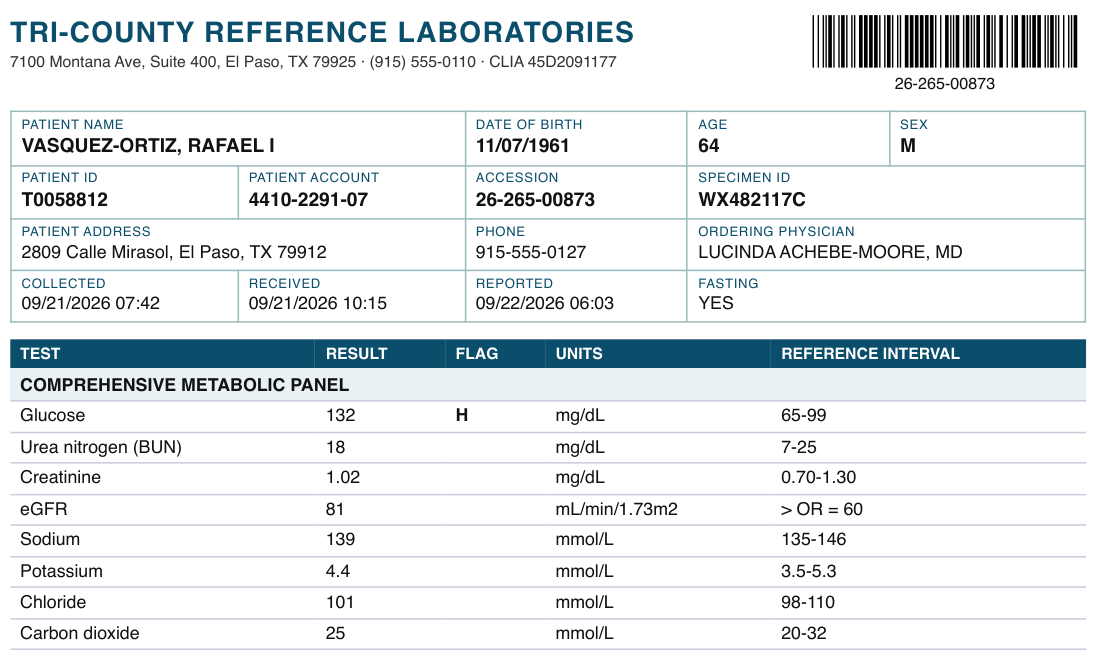
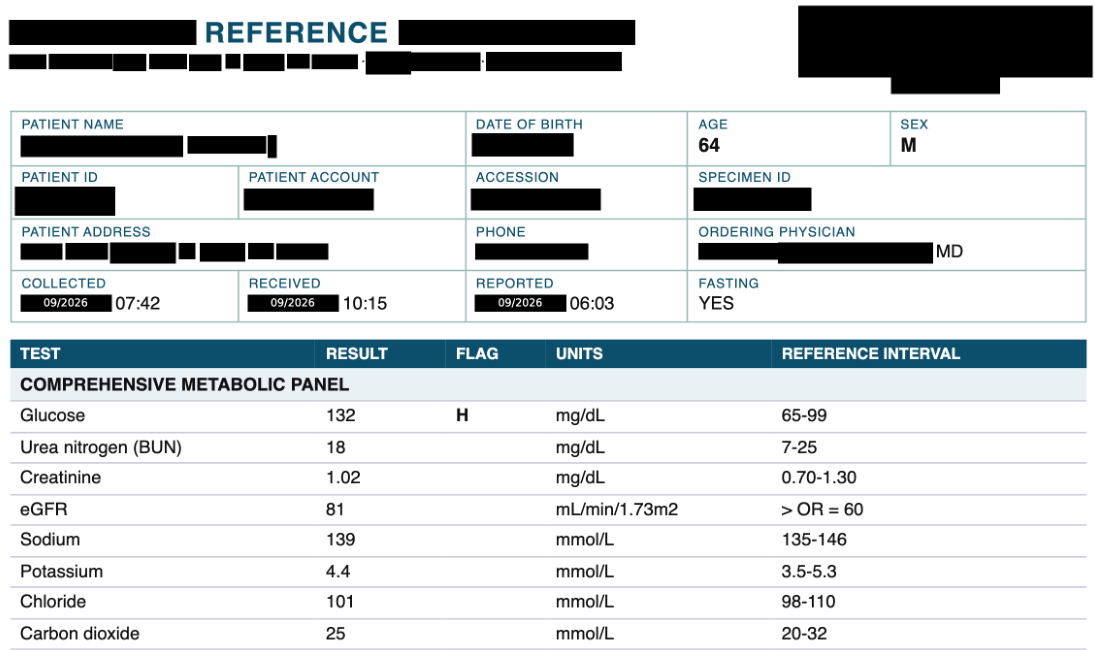
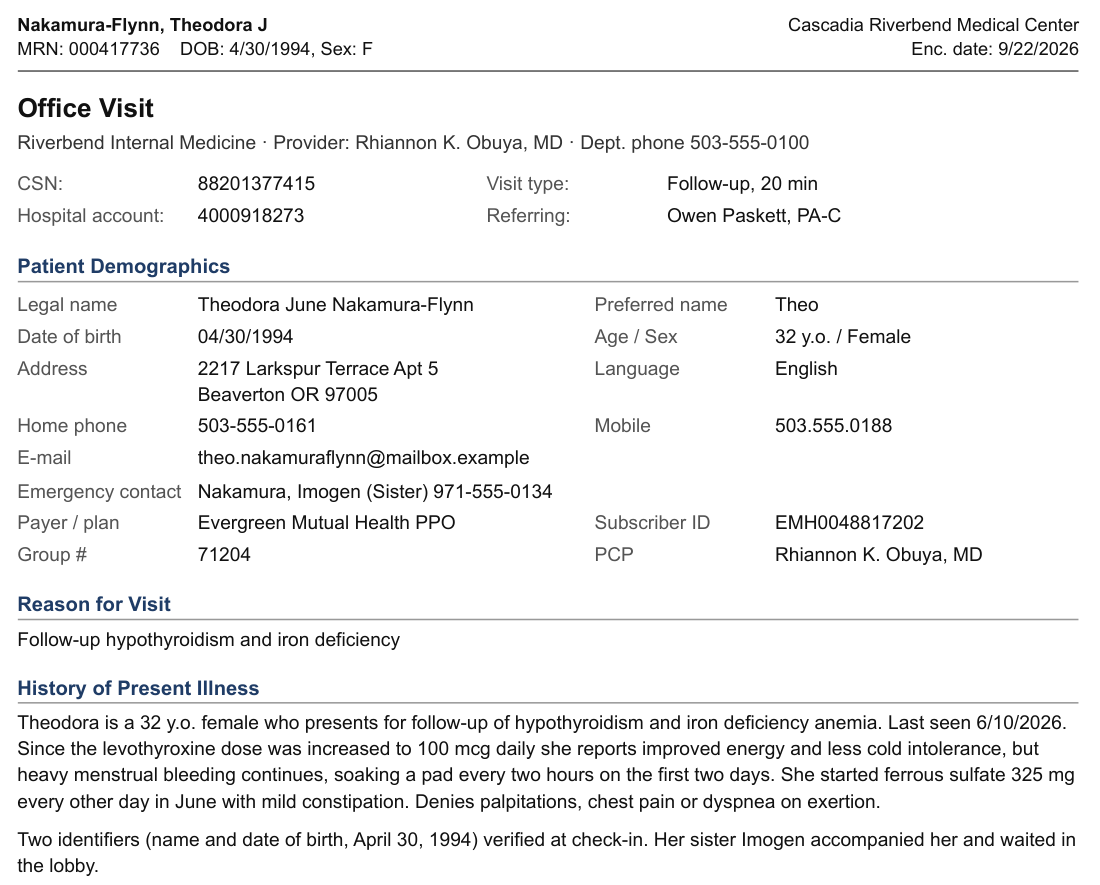
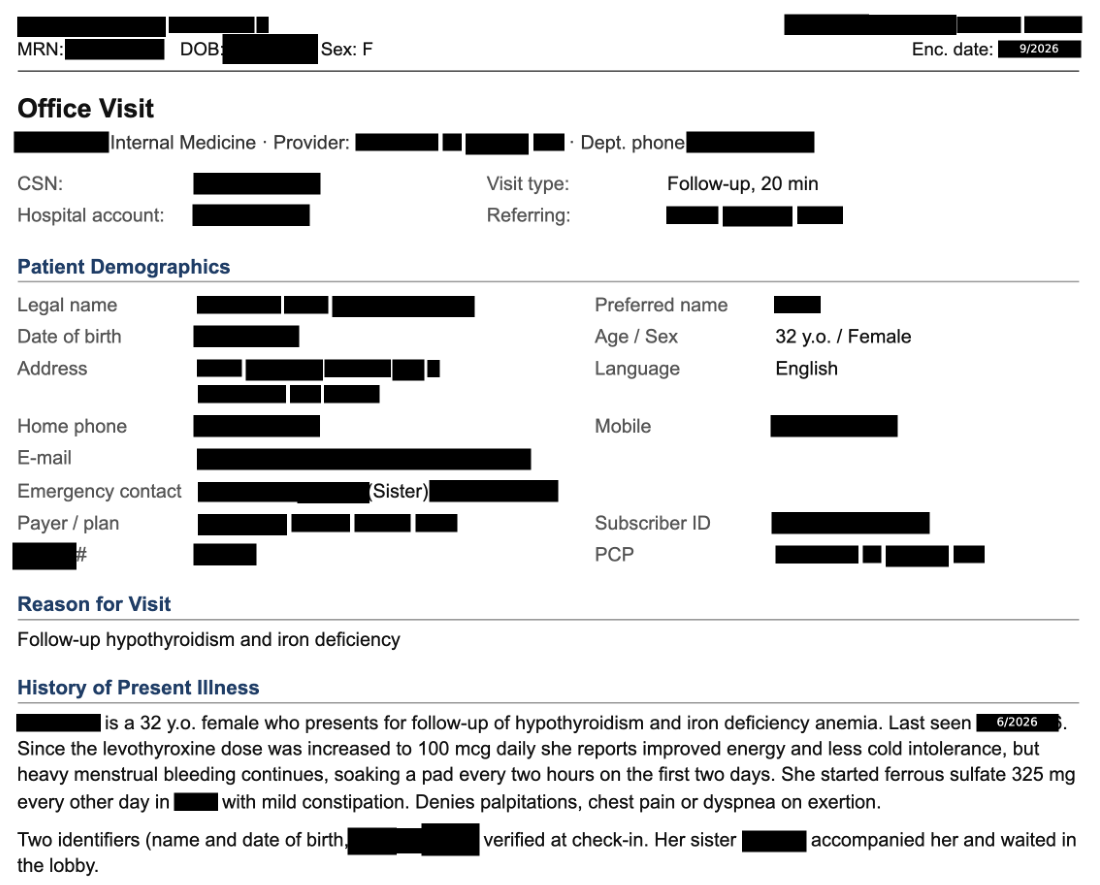
Patient names, dates of birth, record and account IDs, phone numbers, email addresses, street addresses and relatives' names.
Clinical content kept
Diagnoses, history, medications and doses, results, units and reference ranges are left unredacted.
Dates generalised
Dates can be generalised to month and year, so 9/22/2026 becomes 9/2026.
How well the engine finds patient identifiers
On our benchmark, the engine removed 3,084 of 3,099 patient identifiers. Automatic redactions are then checked by human review.
Of patient identifiers removed: 3,084 of 3,099.
On 57 held-out documents.
Clinical content preserved.
About 5 seconds per page on a standard laptop.
By identifier type, on our benchmark
Castor's benchmarkShare of patient identifiers removed. How this compares with people redacting by hand: manual redaction vs the redaction engine.
Castor's benchmark: 146 documents (585 pages, including 12 real patient records). Castor figures are internal benchmarks, not peer-reviewed.
How people do at finding identifiers, and where they miss them
Published studies measured how many identifiers trained people find in typed clinical notes. The results depend on the documents and the definitions used, so manual redaction is a reference point, not a fixed standard.
- Published studies · people
Manual redaction
Clinicians read typed intensive care unit (ICU) nursing notes and marked the identifiers [Douglass 2004; the same data is reported in Neamatullah 2008].
Even three clinicians together did not remove every identifier. Across studies, a single reviewer found from about 66% [South 2014] to about 96% [Dorr 2006], depending on the documents.
- Castor's benchmark · the engine
The redaction engine
The Castor Catalyst redaction engine on our benchmark: 146 documents, 585 pages, including 12 real patient records.
Different documents and definitions; not a head-to-head test. The engine and the people in these studies were never measured on the same documents.
Where people miss identifiers
Two annotators each checked 350 paediatric hospital notes [Deleger 2013]. They were strongest on phone numbers, dates and names, and weaker on ID numbers, institutions, locations and other identifiers.
Share of identifiers of each type found: the solid bar is the lower of the two annotators' results, the lighter part reaches the higher one.
- A process failure, not a recall measurement
When the black box isn't a redaction
In a review of US court filings, 194 documents had text still readable under redaction boxes, including medical information, addresses and dates of birth [Lee 2011]. A box drawn over text is not a redaction: that is why path A uses Acrobat Pro redaction with hidden information removed, and why drawn boxes are on the list of things to avoid.
- Time, in typed notes
Manual redaction takes time
About 87 seconds per note [Dorr 2006], and about 18,000 words per clinician-hour [Neamatullah 2008].
Redaction is a separate service from the AI pipeline
The Catalyst Source Gateway redacts, with no large language models. Hosted on Microsoft Azure; no other subprocessors. The Catalyst pipeline extracts. Only redacted copies pass from one to the other. The providers used in a study, such as Google for AI extraction, are in Castor's sub-processor list.


Which path fits which document
The site can redact any of its own documents itself before upload. Each document type below fits paths A, B and C. Handwritten notes are redacted by the site only.
Imaging or lab report
Check every page, including headers and footers.
Typed PDF export
Check headers, footers and file properties. In path A, sanitise to remove hidden text.
Fax
Check the fax header line on every page and the "Re:" line on the cover sheet.
Medical record screenshot
Check the patient banner, window title, tabs and any second patient. In path A, redact the banner; cropping is not enough.
Scanned worksheet
Check faint or skewed pages, the back of every page, and handwriting: the site redacts handwritten identifiers itself on every path. In path A, mark image areas by hand.
Phone photo
Check page edges and anything else in frame, such as wristbands. Rescan flat if possible.
Handwritten notes: path A only
The site redacts them and checks every page: names, signatures, initials and margin notes. Reviewers check redacted copies.
Path B, in-browser redaction: Coming soon
What the site does, in every path
Five steps the site can copy into its own procedure.
- Step 1
Check the approvals
The study's approvals cover the upload, for consented participants.
- Step 2
Choose the path
The one the site's privacy officer and standard operating procedure (SOP) allow.
- Step 3
Keep study dates readable
Where the electronic case report form (eCRF) needs them.
- Step 4
Upload only what the study needs
Under the right participant ID. In the Catalyst pipeline, an automated check on the redacted copy confirms each document matches the participant.
- Step 5
Approve the redactions before submission
In every path. A wrong upload can be deleted before it is processed.
Avoid
Patient names, initials, record numbers or birth dates in file names. Drawn boxes or highlighter in a PDF viewer: the text stays underneath. Redacting the original source record. Emailing unredacted documents outside the upload screen.
Agreements for path C
Paths A and B are the site's own step. If Castor redacts uploads for the site (path C), a separate agreement with the site may be needed, such as a business associate agreement (BAA) in the US or a data processing agreement (DPA) in the EU. Ask your Castor contact.
A redacted copy is still protected data
The redacted copy Catalyst works on is still protected health information (PHI) under HIPAA and personal data under the General Data Protection Regulation (GDPR). The study's agreements and approvals are on the data journey page.
Path C for French sites
Health data hosting certification (hébergeur de données de santé, HDS) applies to hosted health records of French patients, including redacted copies. For French sites, Castor redacts (C) only once HDS is confirmed for the study.a
Three people to talk to first
Before the site's first upload, settle the path and the paperwork.
The site's privacy officer
Which path and which local tool the site's SOP allows.
The study monitor
How source verification runs for the path the site chooses.
Your Castor contact
Questions about path C for the site.