Retyping source data is slow and error-prone. Catalyst turns it into study data, under the sponsor's or CRO's review policy.
Version 2.1 · Updated 16 October 2026
Castor Catalyst is an AI extraction layer for clinical studies. It turns worksheets, scans and electronic medical record (EMR) pages into values in the electronic data capture (EDC) system, checked under the review policy the sponsor or CRO sets.
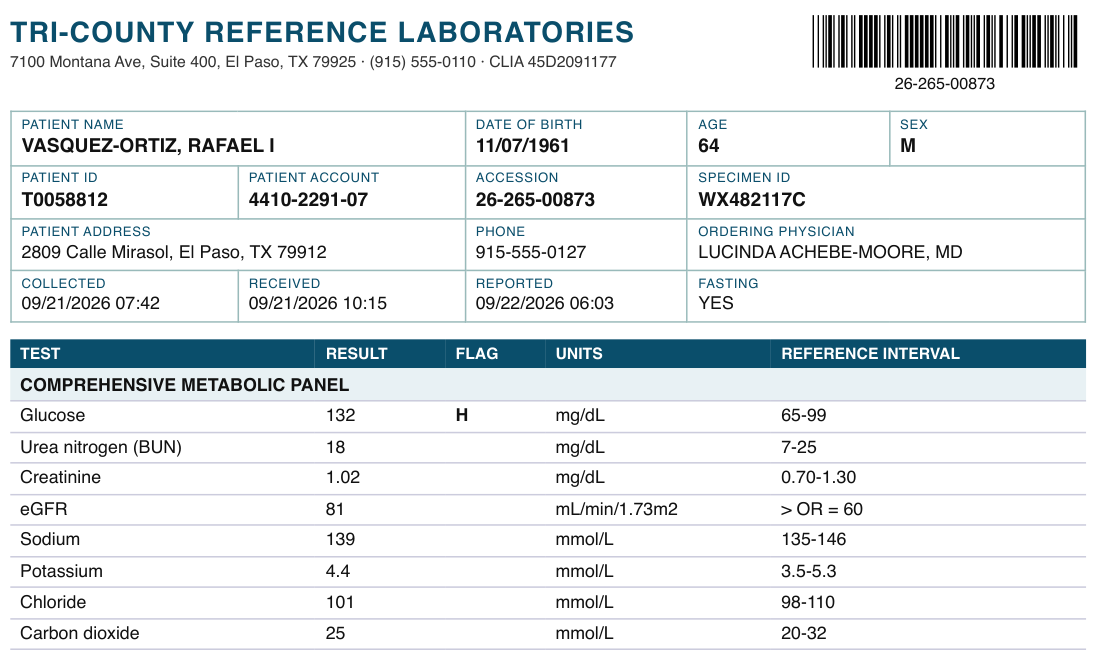
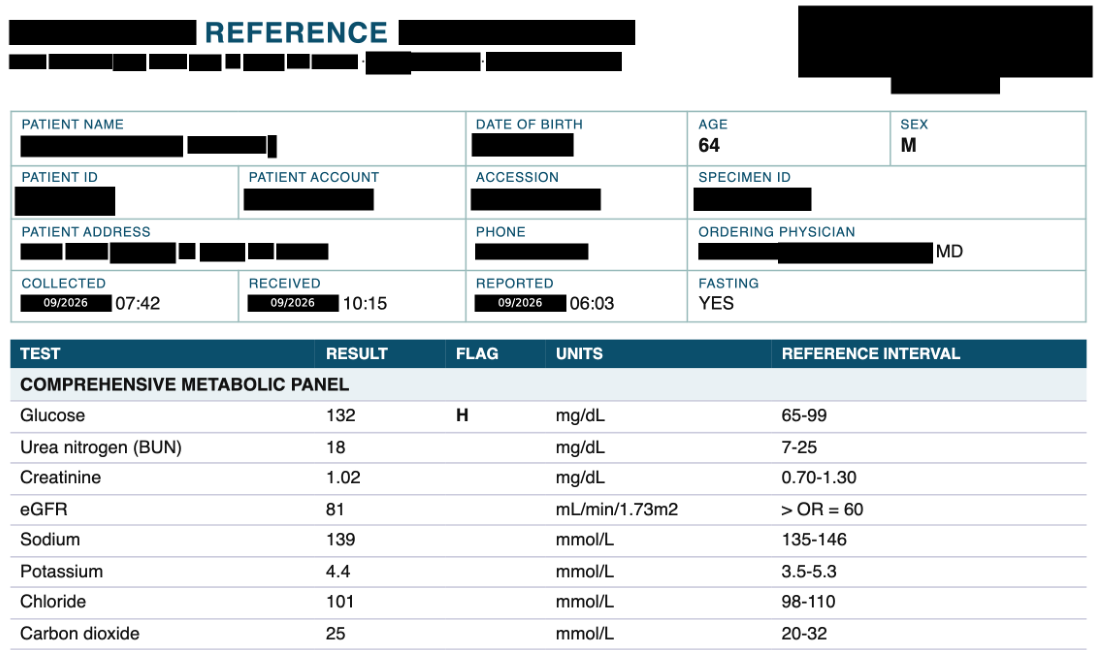
A workflow, not one model
Five stages with a check at each: intake, redaction, extraction, review and commit to the EDC.
Redacted before extraction
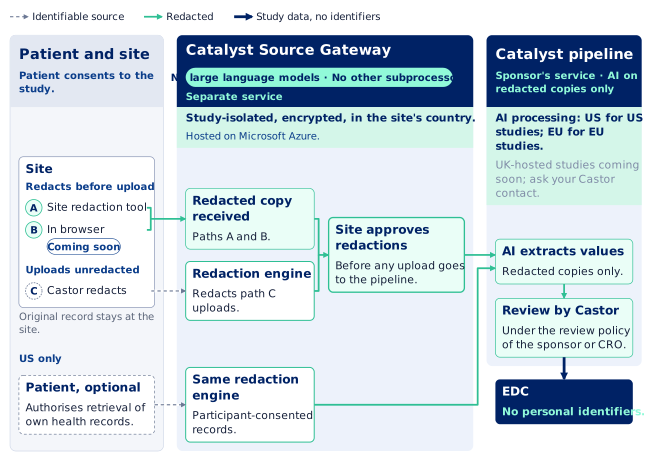
Redaction uses no large language models, and the site approves every redaction. The AI pipeline only ever sees redacted copies.
You set the review policy
100% human review today, with every action in the audit trail. Risk-based review is coming soon. Coming soon
The redaction engine finds identifiers with rules and small purpose-built recognisers trained only on synthetic documents; no large language models and no external services.
Faster than abstraction by hand, with fewer errors
Minutes per chart
Castor internal benchmarking.
Data errors
Two sources: manual from a published meta-analysis of 93 studies;1 Catalyst from Castor's internal benchmark.
Identifiers redacted
Engine: Castor's benchmark. Clinician: a published study on a different document set.2 People check the redactions, and the site approves them.
- Castor internal analysis80%
Lower cost of chart abstraction. Castor internal analysis of 12 comparative studies.
- Production telemetry0.8%
Of AI-extracted values changed by reviewers, in one live paper-based study in 2026.
Sites in the US and Europe already use Catalyst in live studies. Three anonymised studies are in the case studies.
- 40+sites
- 4countries
- 350+source documents
- 15,000+data points
- United States
- Germany
- United Kingdom
- France
Identifiers are redacted before any AI reads the source
Two Castor services, kept apart. The Catalyst Source Gateway redacts identifiers for the site, with no large language models. Hosted on Microsoft Azure; no other subprocessors. The Catalyst pipeline extracts values for the sponsor, from redacted copies only. The providers used in a study, such as Google for AI extraction, are in Castor's sub-processor list.

Regions
AI processing runs in the US for US studies and in the EU for EU studies.
UK-hosted studies: Coming soon Ask your Castor contact.
No training on your data
Castor doesn't train AI models using your data from Catalyst.
Today every extracted value goes to a reviewer
Castor reviewers work under the policy the sponsor or CRO sets; the investigator remains responsible for the study data.
- 100% human review
A person reviews every extracted value before it reaches the EDC.
- Risk-based review Coming soon
Values above the confidence threshold the sponsor or CRO sets go to the EDC without a person, and the fields the sponsor or CRO picks, such as adverse events and primary endpoints, always go to a reviewer.
What quality and IT teams will check
For the study, the sponsor is the data controller and Castor its processor.
21 CFR Part 11
US electronic records rules, and EU Annex 11. The sponsor or CRO validates.
ISO/IEC 27001
Since 2017. Also ISO 9001 (since 2018) and NEN 7510 (since 2017), the Dutch healthcare security standard.
GxP validation
Validation package from Castor quality assurance, on request.
Test Catalyst on the study's own documents
Share a protocol and sample documents; synthetic samples are welcome. Castor benchmarks the extraction on them.