Trusted by research teams running eCOA and ePRO worldwide
Traditional eCOA and ePRO setups leave teams carrying fragmented capture and unsupported builds. Here is what each problem becomes on Castor.
eCOA and ePRO data flows to the EDC you already run, whichever vendor it is.
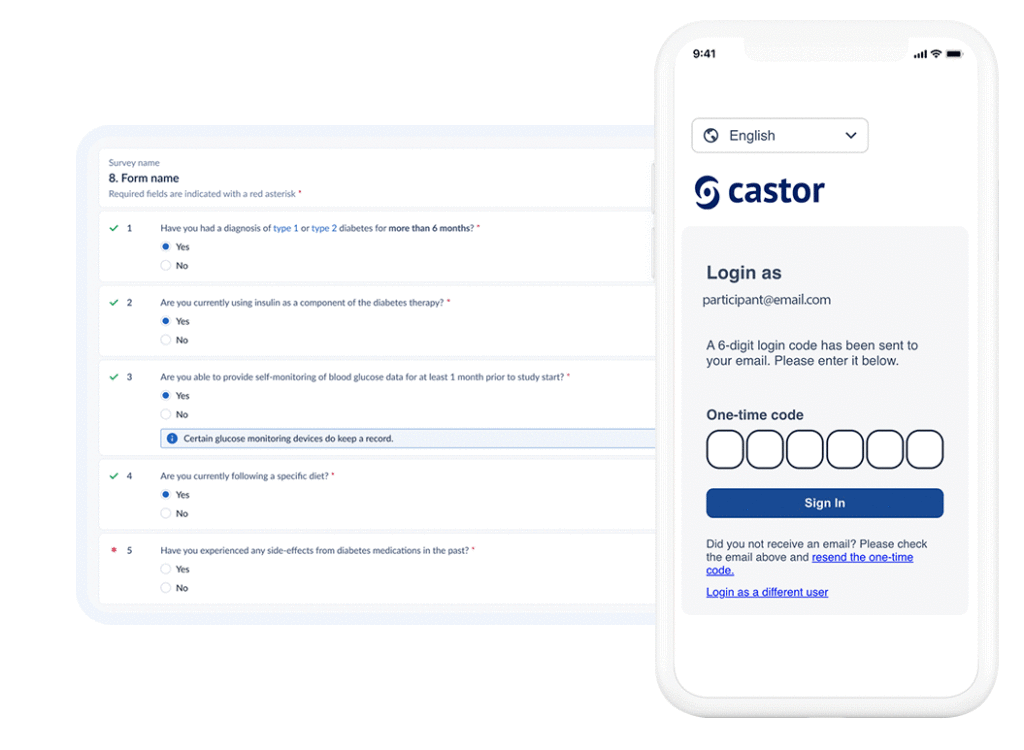
Patient compliance reached 92% in a large multinational Phase III trial. Consumer-grade ePRO on patients’ own devices replaces the paper diaries and clunky apps that leave completion gaps and recall bias.
Castor captures patient data multilingually across web ePRO and the patient app, with a library of validated instruments, so global trials run in patients’ own languages.
With managed Professional Services, builds reach UAT in weeks, not months, and your team reviews and approves instead of building. Full time-to-value figures are below.
Capabilities that turn patient-reported and clinician-reported data into clean, decision-ready evidence.
eCOA and ePRO integrate with your existing EDC, whichever vendor you run. Event-driven data integration via webhooks and open REST APIs keeps connected systems in sync as data is captured. Patient-reported and clinician-reported data lands in real time, with one audit trail on the Castor side.
No rip-and-replace, and cleaner data at lock.
App-based and browser-based capture on patients’ own devices, with provisioned devices where needed.
Lower provisioning cost and burden, higher completion.
Common instruments are available in the library, and Castor’s Professional Services team manages the scale licensing and validation, so you do not navigate instrument copyright yourself.
Faster build, licensing handled for you.
Live compliance dashboards and configurable alerts flag low completion and missing data as it happens.
Catch problems while you can still act, not at lock.
Multilingual patient capture and local infrastructure worldwide, covered in the global infrastructure section below.
Global reach without rebuilding for every market.
AI-enabled study builds and AI-enabled electronic migration of validated instruments accelerate setup, complex visit scheduling is handled in the build, and time-travel functionality lets testers simulate future visit windows during UAT instead of waiting for them in real time. These steps are AI-assisted, and your study team reviews and approves the output.
Builds and UAT measured in days, not calendar cycles.
Castor eCOA is a service, not software handed over at go-live. Professional Services carries the specialist work that usually lands on your study team.
Castor runs eCOA, ePRO, ObsRO, and ClinRO as one managed program. See how Castor compares in our eCOA software comparison.
Small and mid-size biotech teams often go live and then find themselves on their own when a protocol amendment lands. Castor bundles data management with eCOA, so the team that builds your study stays with it, handles mid-study changes, and locks your data on time.
You are not left to fend for yourself after go-live.
Protocols that mix patient, clinician, and observer assessments usually mean stitching separate tools together. On Castor, ePRO, ObsRO, and ClinRO live in one study and one audit trail, so your clinical operations team runs a single managed program instead of reconciling three.
Patient, caregiver, and clinician data in one place, built and managed for you.
eCOA (electronic clinical outcome assessment) is the broad category for collecting clinical outcome data electronically. It covers four assessment types: patient-reported (ePRO), clinician-reported (ClinRO), observer-reported (ObsRO), and performance outcomes (PerfO). ePRO is the subset reported directly by patients, such as symptom severity, quality of life, and treatment side effects.
| Dimension | eCOA | ePRO |
|---|---|---|
| What it is | The broad category for electronic outcome assessment | A subset of eCOA reported directly by patients |
| Who reports | Patients, clinicians, observers, or performance tasks | Patients only |
| Assessment types | ePRO, ClinRO, ObsRO, PerfO | Patient-reported only |
| On Castor | Native ePRO, ObsRO, and ClinRO in one system that integrates with your EDC. PerfO results, such as a 6-minute-walk-test output, are captured through flexible eCRFs. | Captured BYOD, in real time, by the patient |
Symptom diaries, quality-of-life measures, and side-effect reporting, captured BYOD through the Castor patient app and the web against a library of validated PRO instruments, with real-time compliance monitoring.
When the patient cannot reliably self-report, observer-reported outcomes route the instrument to a caregiver or guardian. Common in pediatric, CNS, and dementia trials. ObsRO runs natively alongside patient ePRO.
Clinician-reported outcomes are captured through the EDC as specialized eCRFs and digital physician surveys, sharing one database and audit trail with ePRO and ObsRO. This also supports long-term follow-up such as EU MDR post-market clinical follow-up and real-world evidence.
Electronic capture reduces recall bias and missing data compared with paper, and ePRO that runs inside your eCOA system avoids the reconciliation of a standalone bolt-on. For a primer, read the eCOA and ePRO 101 guide.
Castor eCOA (electronic clinical outcome assessment) and ePRO (electronic patient-reported outcome) let patients, caregivers, and site clinicians complete questionnaires, symptom assessments, and outcome measures electronically at home or on site. Data flows into the trial database without paper or manual entry, reducing transcription errors. The platform is built for 21 CFR Part 11 and EU Annex 11, supports HIPAA and GDPR compliance, works on smartphones, tablets, and computers, and captures data multilingually across the patient app, web, SMS, and messaging apps.
Global trials need more than translation. They need local infrastructure your patients and sites can actually use.
Patient-facing capture is multilingual across the patient app, web ePRO, SMS, and messaging apps such as WhatsApp and WeChat, with 15 to 20 out-of-the-box languages and study surveys buildable in any language, so data quality holds outside English-speaking markets.
Tier-1 patient technical support is available as an optional, scoped service, with the regions and languages set by what the study requires.
For studies in China, patients complete eCOA through native WeChat, the app they already use every day, instead of installing a separate clinical app.
Local server hosting in Australia supports studies in the region and their data residency expectations, so nearby sites run on infrastructure close to home.
Platform scale and study-level results, each stated with its source.
supported with patient-reported outcomes to date, with 202 million+ ePRO datapoints captured globally
“Running our patient-reported outcomes on the same database as our EDC removed an entire reconciliation step. Our team sees compliance issues in real time instead of at lock.”
Innovation Project Manager, Top 10 large pharma
Builds reach UAT in 4-8 weeks for low-to-medium complexity and 8-12 weeks for high complexity with managed Professional Services, ahead of the legacy industry average of 12-16 weeks.
Recognized as a Major Contender in Everest Group’s Life Sciences eCOA Products PEAK Matrix® Assessment 2025, and rated strongly for customer loyalty in ISR’s 2025 eCOA/ePRO Benchmarking.
ePRO for quality-of-life endpoints across long, complex assessment schedules.
Symptom diaries and patient-reported endpoints for small, dispersed populations.
High ePRO burden and caregiver-reported ObsRO through a patient-friendly BYOD experience.
eCOA (electronic clinical outcome assessment) is the broad category for collecting clinical outcome data electronically. It covers four assessment types: patient-reported (ePRO), clinician-reported (ClinRO), observer-reported (ObsRO), and performance outcomes (PerfO). ePRO is the subset reported directly by patients. On Castor, ePRO, ObsRO, and ClinRO are captured natively in one system that integrates with your EDC, and performance outcome results are captured through flexible eCRFs.
ePRO (electronic patient-reported outcome) is a subset of eCOA that captures outcomes reported directly by patients, such as symptom severity, quality of life, and treatment side effects. ePRO data is collected directly from the patient without clinician interpretation.
eCOA refers to the electronic collection of clinical outcome data, replacing paper diaries and questionnaires. It covers four assessment types: patient-reported (ePRO), clinician-reported (ClinRO), observer-reported (ObsRO), and performance outcomes (PerfO). Electronic capture time-stamps each entry and reduces the transcription errors common to paper.
EDC (electronic data capture) is used by investigators and site staff to enter site-collected data. eCOA is used by patients, caregivers, or clinicians to capture outcome data, often between site visits. Castor eCOA integrates with any major EDC, so outcome data flows to your trial database without a separate reconciliation step.
Castor offers a library of validated instruments, including common measures such as EORTC, FACT-G, EQ-5D, SF-36, and PROMIS, plus therapeutic-area-specific instruments where they are used. Castor’s Professional Services team manages the scale licensing and validation, so you do not navigate the instrument copyright and licensing process yourself. Instruments can be deployed from the library rather than rebuilt for each study.
Yes. BYOD lets patients use their own smartphones, which reduces provisioning cost and improves compliance. It requires attention to device compatibility, version control, and data security. Castor supports both app-based and browser-based BYOD, with provisioned devices available where a patient has none.