Electronic clinical outcome assessment (eCOA) software has become a standard component of modern clinical trials. This page provides an honest, factual overview of the major eCOA platforms available to clinical research teams in 2026, covering what eCOA software does, what features differentiate the leading vendors, and how to approach selecting the right solution for your trial.
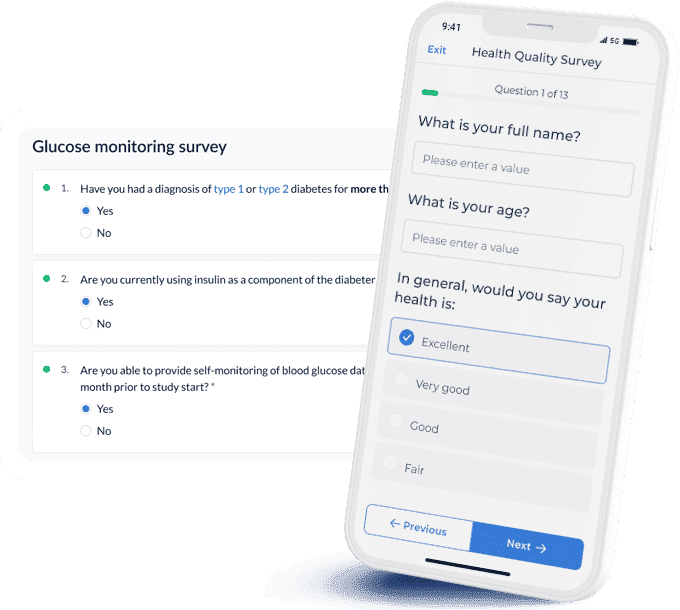
eCOA software is used in clinical trials to collect assessments of patient health outcomes electronically. The term encompasses four distinct types of clinical outcome assessments, each serving different measurement purposes in clinical research.
| eCOA type | Who completes it | Examples |
|---|---|---|
| ePRO | Patient | Symptom diaries, quality of life questionnaires, pain scales |
| eClinRO | Clinician or investigator | Structured clinical assessments, severity scales |
| eObsRO | Caregiver or observer | Caregiver ratings for pediatric or cognitively impaired patients |
| ePerfO | Patient (observed performance test) | Cognitive tests, physical function tests |
The FDA’s 2009 PRO Guidance and subsequent documentation explicitly supports the use of electronic collection for patient-reported outcomes. The EMA has similarly addressed eCOA in its reflection papers on PRO instruments. Both agencies require sponsors to demonstrate that electronic collection does not alter the measurement properties of validated instruments. For instruments being used electronically for the first time, vendors and sponsors typically conduct migration validation studies to confirm equivalence between paper and electronic versions.
From Phase 1 oncology studies to large Phase 3 cardiovascular trials, eCOA platforms offer measurable advantages over paper-based data collection.
eCOA eliminates the recall bias inherent in paper diaries completed retrospectively. Patients receive notifications to complete assessments at the appropriate time, and data is timestamped automatically. This improves data quality and provides more accurate measurement of health outcomes.
eCOA platforms enforce validation rules (range checks, required fields, skip logic) before data is submitted, reducing the need for queries and data cleaning. Site staff spend less time on manual data entry and correction, and more time on patient care and enrollment.
Both the FDA and EMA explicitly endorse electronic collection for patient-reported and clinician-reported outcomes. Regulators have published specific guidance on PRO measures, eCOA validation, and the requirements for demonstrating that electronic collection does not alter the measurement properties of validated instruments.
eCOA data flows directly into the trial database, reducing manual transcription and data reconciliation. In decentralized and hybrid trials, eCOA enables participants to complete assessments from home without site visits, lowering operational costs and improving participant convenience and retention.
Not all eCOA platforms are built the same way. The right choice depends on your trial type, patient population, integration needs, and budget. Here are the most important factors to evaluate when comparing solutions.
Some vendors maintain libraries of pre-validated questionnaires (EQ-5D, FACT-G, PHQ-9, GAD-7, and hundreds of others) along with migration validation packages. A large validated library reduces study startup time and regulatory risk.
BYOD allows participants to complete assessments on personal smartphones, improving convenience. Device provisioning supplies dedicated devices, offering more control. Some vendors support both. The choice depends on your participant population, trial phase, and geographic scope.
Patients in areas with poor connectivity may need to complete assessments without an internet connection. Look for offline-capable apps that sync data automatically when a connection is restored. This is particularly important in decentralized trials.
eCOA data often needs to flow into the same database as investigator-entered data. Tight integration between eCOA and EDC (whether via a unified platform or a well-maintained API) reduces data reconciliation complexity and site burden.
For Phase 2/3 trials using randomization and blinded drug supply management, integration between eCOA and the IRT/RTSM system is important. Some vendors offer eCOA and RTSM as a combined offering; others require integration between separate vendors.
Global trials require eCOA instruments translated and culturally adapted for multiple languages. Evaluate vendors’ experience with managing multilingual studies, including cultural adaptation documentation accepted by regulators.
eCOA systems must comply with FDA 21 CFR Part 11 and EU Annex 11. Confirm that vendors provide full validation documentation (IQ/OQ/PQ) and that their Computer System Validation (CSV) approach is appropriate for your regulatory context.
Dedicated eCOA vendors offer deep specialization in patient engagement and outcome measurement. Integrated platforms (combining EDC, eConsent, and eCOA in one system) reduce the number of vendor relationships and technology integrations. The right model depends on your trial complexity and preferences.
Below is a factual overview of the major eCOA platforms used in clinical research. This is not an exhaustive list, and the clinical trial software landscape evolves regularly. Contact vendors directly for current capabilities, pricing, and implementation timelines.
Castor is an integrated clinical trial platform that includes eCOA/ePRO alongside EDC, eConsent, and decentralized trial capabilities. Castor’s eCOA module supports all four assessment types (ePRO, eClinRO, eObsRO, ePerfO) and offers BYOD and site-provisioned device options. It is widely used by academic research institutions, biotech companies, CROs, and medical device manufacturers. The integrated model means eCOA data and EDC data are managed within the same system, reducing the need for cross-system data reconciliation. Castor is designed to be fast to set up, easy to use, and accessible to research teams without extensive technical resources.
Clario is one of the most established eCOA specialists in the industry, formed through the merger of ERT and Bioclinica. Clario maintains one of the largest libraries of validated eCOA instruments and has long-standing relationships with large pharmaceutical companies running complex global trials. In addition to eCOA, Clario provides cardiac safety services, medical imaging, and other endpoint management capabilities, making it a comprehensive solution for sponsors requiring multiple endpoint services from a single provider. Clario is typically deployed in large Phase 2/3 programmes with complex study requirements.
IQVIA is a global clinical research organization and technology company whose eCOA capabilities are offered as part of a broader integrated technology platform alongside EDC, CTMS, and safety reporting. IQVIA’s eCOA is designed to work within the wider IQVIA clinical technology ecosystem, making it a natural choice for sponsors already using IQVIA’s full suite of clinical trial services. IQVIA offers eCOA alongside data management, biostatistics, and regulatory support services, providing end-to-end trial support.
Signant Health (formerly CRF Health and BioClinica eSolutions) specializes in patient engagement technologies for clinical trials, with eCOA, eConsent, and RTSM as its core offerings. Signant is recognized for its patient-facing technology and its emphasis on patient-centric trial design. The platform supports both BYOD and device provisioning, and Signant has particular experience in patient compliance programs and notifications to improve eCOA completion rates.
Suvoda specializes in Interactive Response Technology (IRT) combined with eCOA, offering a tightly integrated solution for trials where randomization, drug supply management, and patient-reported data need to work together. Suvoda is particularly well-established in oncology and rare disease trials, where complex randomization schemes and frequent adaptations are common. The combined IRT+eCOA model is Suvoda’s primary differentiator in a market where many vendors offer these capabilities separately.
YPrime offers eCOA and RTSM solutions with an emphasis on flexibility and responsiveness to trial-specific requirements. The company is known for a consultative approach to study design and the ability to accommodate complex protocol requirements. YPrime supports both BYOD and device provisioning and serves a range of trial sizes from Phase 1 to Phase 3, with particular strength in mid-market sponsors.
Kayentis is a European eCOA specialist founded in France with particular strength in the EU clinical research market. The company offers eCOA and eConsent capabilities with a focus on patient-centred design and regulatory compliance in European trials. Kayentis works across therapeutic areas and trial sizes, with a notable presence in academic and mid-market clinical research in Europe.
Veeva’s eCOA capability is part of the Vault Clinical Suite, which includes Vault EDC, Vault CTMS, Vault eTMF, and other clinical systems. Veeva eCOA is designed for sponsors already using or migrating to the Vault ecosystem. Veeva has been gaining significant market share in clinical technology, and its eCOA offering benefits from deep integration with other Vault applications, making it attractive to sponsors seeking a unified Vault environment.
ClinicalInk combines eCOA with EDC in a unified platform, similar to the integration approach taken by Castor. The company differentiates on user experience and the ability to set up studies rapidly. ClinicalInk serves mid-market pharmaceutical, biotech, and CRO clients and is known for its collaborative approach to implementation.
Medable focuses on decentralized and hybrid clinical trial technology, with eCOA as one component of a broader patient-facing technology suite that also includes eConsent, telemedicine, and patient recruitment tools. Medable is particularly relevant for trials adopting DCT-first or digital-first designs where minimizing site visits is a primary goal.
The table below provides a high-level feature comparison to assist with vendor evaluation. Capabilities evolve frequently. We recommend verifying current capabilities directly with each vendor before making platform selection decisions.
| Feature | Castor | Clario | IQVIA | Signant | Suvoda | Veeva | ClinicalInk | Medable |
|---|---|---|---|---|---|---|---|---|
| ePRO / eCOA support | ✓ | ✓ | ✓ | ✓ | ✓ | ✓ | ✓ | ✓ |
| eClinRO support | ✓ | ✓ | ✓ | ✓ | ✓ | ✓ | ✓ | Partial |
| eObsRO support | ✓ | ✓ | Partial | ✓ | ✓ | Partial | ✓ | Partial |
| ePerfO support | ✓ | ✓ | – | Partial | – | – | – | – |
| BYOD support | ✓ | ✓ | ✓ | ✓ | ✓ | ✓ | ✓ | ✓ |
| Device provisioning | ✓ | ✓ | ✓ | ✓ | ✓ | ✓ | ✓ | Partial |
| Offline mode | ✓ | ✓ | ✓ | ✓ | ✓ | Partial | ✓ | ✓ |
| Integrated EDC | ✓ | – | – | – | – | – | ✓ | – |
| RTSM / IRT integration | API | API | – | Integrated | Integrated | API | API | API |
| Multilingual support | ✓ | ✓ | ✓ | ✓ | ✓ | ✓ | ✓ | ✓ |
| Integrated EDC + BYOD | ✓ | – | – | – | – | – | ✓ | – |
| Academic/small trial focus | ✓ | – | – | Partial | – | – | ✓ | Partial |
| Enterprise/large pharma | Yes | Yes | Yes | Yes | Yes | Yes | Yes | Partial |
The FDA’s 2009 PRO Guidance and subsequent documentation explicitly supports the use of electronic collection for patient-reported outcomes. The EMA has similarly addressed eCOA in its reflection papers on PRO instruments. Both agencies require sponsors to demonstrate that electronic collection does not alter the measurement properties of validated instruments. For instruments being used electronically for the first time, vendors and sponsors typically conduct migration validation studies to confirm equivalence between paper and electronic versions.
No single eCOA platform is the right choice for every trial. The following considerations will help you narrow the field efficiently.
Phase, therapeutic area, patient population, geography, and complexity all influence which platform fits best. A large Phase 3 cardiac safety trial has different needs than a smaller Phase 1 or Phase 2 study. A decentralized trial with participants in remote locations requires different capabilities than a traditional site-based trial. Early clarification of these requirements narrows the vendor pool significantly.
If your trial already uses an EDC system, evaluate whether adding a separate eCOA vendor or choosing an integrated platform makes more operational sense. Separate vendors offer flexibility and specialized depth. Integrated platforms reduce the number of vendor relationships and can simplify data management. There is no universal right answer: the best choice depends on your trial structure and team preferences.
If your trial uses randomization and trial supply management, the eCOA-IRT integration point is critical and should be evaluated explicitly. Some vendors offer eCOA and IRT as a single integrated solution. Others require a data transfer agreement between separate systems. For complex randomization schemes, the integrated model often reduces operational complexity.
Larger pharma programs with complex global requirements often benefit from enterprise specialists with deep experience in multinational trials. Smaller or faster-moving academic or startup teams often prefer simpler, faster-to-deploy integrated platforms. There are excellent options in every category. The key is matching platform maturity to your organization’s needs.
Ask all vendors for their validation documentation packages (IQ/OQ/PQ), their approach to eCOA instrument migration validation, and their experience with the specific regulatory markets you’re submitting to. Regulatory compliance should not be an afterthought: the best time to discuss it is during vendor selection.
ePRO (electronic patient-reported outcome) is one type of eCOA, specifically data reported by the patient without interpretation by a clinician. eCOA is the broader category that also includes eClinRO (clinician-reported outcomes), eObsRO (observer-reported outcomes), and ePerfO (performance outcomes). In practice, the terms are often used interchangeably in the clinical trial industry, but ePRO is technically a subset of eCOA.
Yes. The FDA issued guidance on patient-reported outcome measures in 2009 and has subsequently published specific guidance supporting electronic collection. The EMA has published reflection papers addressing eCOA in clinical trials. Both agencies accept eCOA data for regulatory submissions, provided the electronic instrument has been properly validated and the migration from paper (if applicable) has been demonstrated to not alter the measurement properties of the instrument.
BYOD (Bring Your Own Device) eCOA allows trial participants to complete assessments on their own smartphones or tablets rather than on a study-provided device. BYOD can improve participant convenience and potentially compliance, particularly in decentralized trials where participants complete assessments at home. The main considerations are ensuring consistent app performance across device types and operating systems, and managing data security on personal devices.
eCOA and EDC integration can be handled in two ways: through a unified platform that captures both types of data in the same system, or through a data transfer interface between separate eCOA and EDC systems. Integrated platforms eliminate the need for a separate data transfer agreement and reduce the technical overhead of maintaining two systems. When using separate vendors, sponsors typically establish a data transfer specification so that eCOA data flows automatically into the EDC database at defined intervals.
Yes, eCOA is one of the core technologies that enables decentralized clinical trials (DCTs). BYOD eCOA allows patients to complete assessments from home without site visits. Combined with eConsent for remote enrollment and telemedicine for virtual investigator interactions, eCOA data collection can make fully remote or hybrid trial designs feasible. The FDA’s 2023 DCT guidance specifically endorses remote eCOA as part of decentralized trial designs.