

How patient organizations are driving rare disease drug development
Patient organizations in rare disease are no longer waiting for pharma to act, and a

SaaS eCOA licensing quotes make one number visible: the software cost. Five cost categories reliably go unaccounted for in software-only comparisons, and together they can rival the license itself for complex, multi-language Phase II/III studies. This brief examines each hidden cost, provides a decision framework by study type, and offers a TCO self-check for teams working through this decision before procurement.
A software-only eCOA license is the number that appears in the budget. Everything that makes it work appears somewhere else. This brief breaks down five cost categories that consistently go unaccounted for in SaaS-only comparisons, and shows you how to use them to make a sound build-vs-buy decision before the vendor quote becomes the plan.
For procurement leaders at mid-to-large biotechs, pharma sponsors, and CROs evaluating eCOA solutions, the software license fee is visible. The scale licensing negotiations, linguistic validation rounds, IRB/EC screenshot documentation, device provisioning logistics, and post-go-live monitoring are not. These costs accumulate on your team’s calendar, not the vendor’s invoice.
The true cost of eCOA is not the software. It is the scientific rigor, contract administration, and technical oversight required to protect your primary endpoints from enrollment through database lock. Five cost categories reliably appear below the waterline.
Studies that use a single, non-proprietary assessment instrument are the exception in late-phase clinical trials. Most Phase II/III protocols include multiple validated instruments, each governed by a separate copyright holder with its own licensing terms, royalty structure, and requirements for how the digital presentation must match the author’s original validated version.
Each additional proprietary scale does not add a proportional amount of administrative overhead. It adds a separate licensing engagement with a separate distributor, running in parallel with all the others, while also interacting with your global translation strategy.
Translation is where the overhead compounds significantly. Linguistic validation for a validated PRO instrument in a new language is not a translation task. It requires forward translation, back translation, reconciliation, cognitive debriefing interviews with native-speaking patients, and approval from the copyright holder. For a study requiring that process across 10 or more languages, the coordination alone requires dedicated expertise that most internal clinical teams cannot absorb alongside their other trial responsibilities.
Per ISPOR Good Research Practices for ePRO, a full linguistic validation typically runs 10 to 16 weeks per language.[1] The primary driver of that timeline is not the translation itself. It is finding and recruiting native-speaking patients who match the study population, conducting cognitive debriefing interviews to confirm the translated version measures the same construct as the original, and obtaining copyright holder approval before the language version can be used in the study. For a 10-language study using three proprietary instruments, that process means 30 parallel licensing and validation tracks, each with its own approval gate.
In a SaaS-only model, all of this sits with your internal team. In a managed model, it is a defined deliverable. Your team does not carry the legal, linguistic, and coordination overhead that can delay study start before the first patient is enrolled.
Most eCOA platforms now market a no-code build experience. For simple instruments with linear question flows, that claim is accurate. For complex primary endpoints with adaptive branching logic, real-time constraint validation, and cross-instrument scoring dependencies, it frequently is not.
When no-code configurations are insufficient for the protocol’s requirements, teams face a choice: accept a manual workaround, or pay for custom development that was not in the original software quote. Neither is the clean outcome the initial pricing implied.
Manual workarounds transfer the validation burden from the software to your data managers. Rather than the platform preventing out-of-range entries or incomplete submissions at the point of capture, your DM team inherits query generation and data cleaning that could have been addressed upstream. Sites also lose the benefit of real-time validation feedback, which tends to increase entry error rates during data collection.
Based on Castor’s operational experience across global trials, the personnel overhead of running a compliant internal UAT cycle for a complex, multi-language eCOA build often rivals a meaningful share of the software license cost itself. Castor’s eCOA platform eliminates this manual bottleneck through automated UAT, compressing the traditional 12 to 16 week validation window to under four weeks. For studies where eCOA go-live sits on the critical path to first patient enrolled, that compression changes the study start date, not just the budget line item.
Internal UAT for a SaaS-only build requires more than test accounts and a sign-off checklist. Creating audit-ready test documentation, executing validation scripts, and managing the UAT cycle alongside site training timelines is a personnel project with a non-trivial cost that rarely appears in the budget comparison.
This is the hidden cost most frequently omitted from SaaS-only models, and the one that produces the most consistent surprise for teams building for the first time.
Ethics committees require paper-equivalent screenshots of every patient-facing screen, in every language the study will use. For a protocol with complex branching logic, the screenshot requirement is not just the primary question flow. Every conditional path the patient might encounter requires documentation. Add multiple languages and the volume scales accordingly.
Generating these screenshots requires working builds in every language. Organizing and labeling them requires structured file management. Keeping them current through protocol amendments requires rebuilding that structure every time the questionnaire changes. This is a documentation project that runs alongside the study for its full duration, and in a SaaS-only model, it falls on whoever owns the internal build.
The volume is not abstract. A standard Phase III trial using three validated instruments (EQ-5D, EORTC QLQ-C30, and SF-36) plus two custom symptom diaries generates approximately 30 patient-facing screens. In a 12-language study, that is 360 unique screenshots. Validated across three device formats, iOS, Android, and tablet, the total reaches 1,080 screenshots required per amendment cycle. Castor’s platform automates screenshot generation for validated builds, removing this burden from internal teams entirely and eliminating the risk of screenshot libraries falling out of sync with the current build state.
A managed eCOA provider delivers submission-ready screenshot packages as part of the standard build deliverable and updates them with each amendment. In a SaaS-only model, this is internal work that will not appear on the vendor invoice.
BYOD strategies reduce device procurement costs. They do not eliminate device management.
Patient populations are not uniform. Participants without compatible smartphones, participants who prefer a dedicated device, and protocols with strict offline-capture requirements create scenarios where provisioned devices remain necessary even in BYOD-primary designs. A design that assumes universal smartphone ownership will systematically exclude certain patient populations, which carries both equity and data completeness implications.
In decentralized and hybrid clinical trials with geographically distributed sites, device logistics involve international shipping, customs documentation, battery health monitoring, firmware version management, and remote wipe capability for lost or damaged hardware. These requirements need established vendor relationships and operational processes that most internal clinical teams do not maintain as a standing capability.
The FDA’s guidance on digital health technologies for remote data acquisition explicitly supports BYOD for ePRO collection, provided sponsors ensure cross-device consistency and offer a provisioned alternative for participants without compatible devices.[2] The scale of BYOD deployment in regulated trials is well-established. In the Pfizer/BioNTech BNT162b2 vaccine trial, approximately 79% of the more than 40,000 participants reported ePRO safety outcomes using their own devices.[3] Industry data projects BYOD will be used in 31% of trials by 2026, up from roughly 20% in 2023.[4] None of this eliminates the provisioning requirement for patient segments that cannot use personal devices. It makes operational planning for that segment more important, not less.
The risk profile of an eCOA deployment does not peak at go-live and then decline. It starts at go-live.
The most costly post-go-live problems are the ones that do not generate immediate alerts. A site stops syncing data. A timezone configuration causes timestamps to record incorrectly for a regional patient cohort. A specific device model running an older OS version fails to upload questionnaire responses. In a standard SaaS dashboard, these issues may not surface until they represent a meaningful data gap.
Proactive technical monitoring requires someone watching patterns across the study population. Not reviewing site-level summary statistics weekly, but tracking submission rates, sync anomalies, and regional outliers before they affect database integrity. For studies with primary endpoints that depend on complete and timely eCOA data, catching a silent sync failure at week two has substantially different consequences than discovering it at database lock.
In a SaaS-only model, that monitoring is your team’s responsibility. In a managed model, it is a defined service element with escalation thresholds and a named point of contact.
The five cost categories above are not an argument that full-service eCOA is always the better choice. For certain study profiles, a software-only model delivers genuine cost savings and is the right operational decision.
SaaS-only tends to work well when most of the following conditions apply:
For simple observational studies and registries using non-proprietary instruments, SaaS-only is often the right call. The iceberg costs are real, but they are not equal for every study design. The question is which ones apply to your protocol and what they cost when you carry them internally.
| Study type | SaaS-only | Full-service (managed) |
|---|---|---|
| Simple observational study, non-proprietary instruments, one or two languages | Strong fit where internal resources are available. Cost savings are achievable. | Available at a right-sized scope. Worth requesting a comparable quote to compare total cost before assuming full-service is over-engineered for your study. |
| Biopharma Phase II/III, multiple proprietary scales, global sites and languages | High internal burden. Translation, licensing administration, and IRB documentation generate substantial personnel overhead that is rarely captured in the software quote. | Strong fit. Dedicated PM, linguistic validation, and technical alerting protect primary endpoint data through a high-risk build and deployment cycle. |
| Late-phase medical device trial, complex workflows, provisioned device requirement | High operational risk. Device logistics and validated scripting requirements frequently exceed what internal teams can absorb alongside their other responsibilities. | Essential for most designs. End-to-end management of hardware lifecycle and validated patient-facing capture reduces regulatory risk significantly. |
Before committing to either model, work through these questions. The more that apply to your study, the higher the likelihood that a SaaS-only quote will underestimate the true project cost.
| Question | If yes, factor this into your SaaS cost model |
|---|---|
| Does the study use proprietary instruments requiring copyright negotiation? | Licensing overhead for each instrument and distributor |
| Will the study run in five or more languages? | Linguistic validation cost per language, per instrument, plus string management |
| Does the protocol include complex branching logic or adaptive assessment schedules? | Custom scripting cost, or data manager cleaning burden if no-code is insufficient |
| Will IRB/EC submission require screenshot documentation? | Internal personnel time to generate, organize, and maintain screenshot packs through amendments |
| Are provisioned devices required for any participant segment? | Hardware procurement, international logistics management, and device lifecycle support |
| Does your internal team have dedicated capacity to own UAT? | If not, UAT will compete with other trial responsibilities and may delay go-live |
| Who will own post-go-live technical monitoring? | If no dedicated resource exists, silent failures may not surface until database lock |
One cost category sits outside the five iceberg areas above but is worth naming: the overhead of managing change during execution.
Studies do not execute exactly as planned. Amendments happen. Sites are added or dropped. Scheduling windows change. In a SaaS-only model, each of these events is an internal build task requiring new UAT cycles and updated documentation. In a managed model, protocol amendments are handled by a PM team with existing context about your protocol’s specific logic, configuration, and regulatory submission history.
For studies with a high probability of amendment (early-phase oncology, adaptive designs, real-world evidence studies with evolving data collection requirements), that PM continuity is a value driver that does not appear in the initial software quote but shows up consistently in the final study cost
SaaS-only delivers real cost savings on studies using non-proprietary instruments, running in a small number of languages, and where an internal team has dedicated capacity for UAT, IRB documentation, and post-go-live monitoring. The savings narrow quickly when any of those conditions are absent. For simple observational studies or clinical trial solutions that involve straightforward patient-facing workflows, SaaS-only is often the right operational choice. The iceberg costs described above are real, but their magnitude depends on how many apply to your protocol.
Linguistic validation confirms that a translated instrument measures the same construct as the source version. For validated PRO instruments, most copyright holders require forward translation, back translation, reconciliation, cognitive debriefing interviews with native-speaking patients, and final approval from the rights holder. Per ISPOR Good Research Practices for ePRO, the process typically runs 10 to 16 weeks per language. The primary driver is finding and interviewing native-speaking patients for cognitive debriefing, not the translation itself. For a study requiring ten or more languages, this represents significant timeline and coordination overhead that needs to be planned before the study start date, not discovered during build.
Ethics committees require paper-equivalent screenshots of every patient-facing screen in every language the study will deploy. For a study with complex branching logic and multiple languages, this means maintaining a structured screenshot library that reflects the current validated build and updating it with every protocol amendment. The volume depends on instrument complexity and language count, but this task is rarely captured in a SaaS-only cost comparison because it falls on whoever manages the internal build. It is worth asking any SaaS vendor directly: who generates and maintains the IRB submission screenshot packs?
The most useful question is: what happens when a specific site stops syncing data? Ask how quickly that failure would be detected, who is responsible for detecting it, and what the escalation process looks like before it affects your dataset. A proactive monitoring capability that flags anomalies before they affect database integrity is meaningfully different from a SaaS dashboard that reports what has already happened. Clarifying this distinction before contract signature is worth the conversation, especially for studies where eCOA data supports primary endpoint analysis.
Total costs typically exceed initial vendor quotes by 40-60%. Budget for implementation packages ($50K-200K), validation services ($30K-100K), mid-study modifications (20-30% of initial cost), training packages ($20K-75K), and end-of-study data extraction ($25K-50K) beyond software licensing fees.
Patient organizations in rare disease are no longer waiting for pharma to act, and a
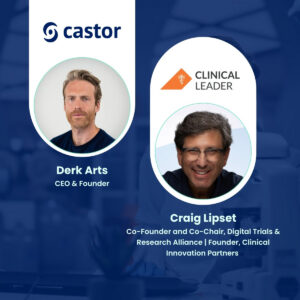
Craig Lipset and Derk Arts on how patient organizations are driving rare disease drug development.

PMCF is a multi-year evidence commitment, the post-market clinical follow-up component of your EU MDR
"*" indicates required fields
Discover all the features offered by Castor EDC
Discover Now