

The real-time monitoring dilemma
When offline eCOA capability compromises the compliance outcomes you're paying for

Lisa Charlton
Chief Product Officer
On this page
Executive Summary
Clinical operations teams mandate offline eCOA capability as standard risk mitigation, yet this requirement creates an unexamined trade-off. While offline functionality prevents data loss during connectivity failures, it eliminates the real-time monitoring capabilities that differentiate 80-95% patient compliance from 11-50% (paper-based) performance. The EMA’s 2023 guidance further complicates this picture by designating offline devices as “source systems” requiring complete local audit trails and justified latency thresholds—compliance requirements most protocols don’t address. With monitoring representing 30% of clinical trial costs[8], organizations face a strategic question: invest in backup connectivity solutions ($12-85/month per site) that preserve full monitoring ROI, or accept operational blindness during disconnection periods while maintaining offline-first architecture for edge cases at institutions where 98.5% have high-speed connectivity[10].
Common assumptions
Offline capability in eCOAElectronic Clinical Outcome Assessment – digital capture of patient-reported outcomes, clinician-reported outcomes, and performance outcomes in clinical trials systems is non-negotiable. It appears in every RFP requirement, every vendor checklist, every risk assessment. The reasoning seems self-evident: if connectivity fails, offline data capture prevents missing data.
But here’s what the compliance data actually shows.
Real-time eCOA systems with automated monitoring achieve 80-95% patient compliance[1]. Paper-based methods (the ultimate “offline” system) achieve 11-50% on-time compliance[1]. The difference isn’t electronic vs paper. It’s real-time monitoring with proactive intervention vs delayed discovery after the fact.
This creates an uncomfortable question for Clinical Operations teams: Are we mandating offline capability while simultaneously undermining the real-time monitoring that actually prevents missing data?
Regulatory guidance and why it matters for Phase 3 trials
While vendors compete on offline synchronization features, two regulatory positions create tension that most organizations haven’t reconciled:
1. ICH E6(R3)International Council for Harmonisation Good Clinical Practice guideline (Revision 3) - international ethical and scientific quality standard for clinical trial design, conduct, recording, and reporting explicitly defines real-time monitoring
ICH E6(R3) revolutionized trial monitoring by defining “centralized monitoring” as including real-time data collection and review[2]. The FDA recommends sponsors ensure “timely access” to clinical trial data, not batch access after extended offline periods.
2. EMAEuropean Medicines Agency - EU regulatory body responsible for evaluation and supervision of medicinal products guidance: when the device becomes "source"
ICH E6(R3) revolutionized trial monitoring by defining “centralized monitoring” as including real-time data collection and review[2]. The FDA recommends sponsors ensure “timely access” to clinical trial data, not batch access after extended offline periods.
This designation triggers specific requirements:
- Audit trailSecure, computer-generated, time-stamped electronic record that allows reconstruction of events relating to creation, modification, or deletion of electronic data must begin “with the initial entry of the data” on the device itself[3]
- Contemporaneous capture means “recording of a clinical observation is made at the same time as when the observation occurred”[3]
- When delays exist, “an acceptable amount of delay should be defined and justified prior to trial recruitment”[4]
- The device must maintain the complete audit trail locally until data transmission
Offline capability fundamentally changes data governance. When devices operate offline, they become source systems requiring complete local audit trail capture, contemporaneous recording validation, and justified latency thresholds (not simple backup mechanisms).
If your device is offline Monday through Thursday, have you defined and justified that latency as “acceptable” per EMA requirements? Have you validated that your device audit trail meets EMA standards for source data systems?
Compliance data doesn't fit the narrative
If offline capability prevents missing data, we’d expect to see:
- Paper diaries (fully offline) performing well
- Real-time systems performing similarly to store-and-forward systems
- Offline digital matching or exceeding online digital compliance
That’s not what happens.
The compliance evidence:
Real-time eCOA systems:
- IQVIA reports up to 95% compliance with automated monitoring and real-time capture[1]
- University of Michigan PROMPT study: 82.6% daily compliance, 92% at 6 weeks, 81% at 18 weeks[5]
- Early Phase 3 eCOA study: 94% patient compliance[1]
Paper-based/delayed methods:
- Paper diaries: 11-50% on-time compliance[1]
- 2002 landmark study: 45% of pain patients forward-filled paper diaries at least once[1]
- Delayed data transmission consistently underperforms real-time systems
Decentralized trials (challenging at-home connectivity):
What differentiates 95% compliance from 11%? Real-time automated alerts that enable proactive intervention before missing data accumulates. That’s the exact capability that offline operation eliminates during disconnection periods.
Monitoring ROI during offline periods
Monitoring represents up to 30% of clinical trial costs[8]. That investment delivers:
- Automated alerts when patients fall behind schedule
- Immediate protocol deviation identification
- Intervention before missing data accumulates
- Real-time eligibility and dosing decisions
- Instant study team visibility
What happens during extended offline periods?
- Real-time compliance alerts: Unavailable (patient falling behind schedule triggers no notification)
- Immediate protocol deviation detection: Delayed (discovered only after sync, when intervention window closed)
- Proactive intervention: Impossible (site coordinators working blind until data syncs)
- Safety signal identification: Retrospective only (adverse events flagged after the fact)
- Automated edit checks and validation rules: Continue functioning offline and sync later (preserved capability)
If monitoring represents 30% of your budget and offline periods eliminate monitoring effectiveness during those periods, what’s the actual ROI?
Hypothetically, a Phase 3 trial with $15M budget spends $4.5M on monitoring capabilities. If sites operate offline even 20% of the time, you’re investing significant monitoring budget for capabilities that deliver no real-time value during disconnection periods.
An alternative approach would be to invest in backup connectivity solutions (mobile hotspots at $12-85/month[9], modern satellite with verified 220 Mbps speeds) that preserve full monitoring capability rather than accept operational blindness during offline periods.
The truth about dead zones
The offline capability debate often conflates different connectivity realities:
Urban research sites (where most trials occur):
- 98.5% of urban Americans have high-speed internet access[10]
- Major research institutions deploying Wi-Fi 6 (significantly improved throughput over Wi-Fi 5)[11]
- Private 5G networks delivering <1ms latency (Boston Children’s Hospital deployed hybrid 5G in 2024; VA Palo Alto implemented private 5G in 2023)[12]
- Private 5G healthcare revenue projected to grow from $22.2M (2024) to $3.7B (2030)[12]
Reality: At well-connected major research institutions conducting Phase 3 trials, offline capability functions as rarely-invoked backup, not primary operational mode.
Rural/resource-limited settings (edge cases, not typical research sites):
- 77.4% rural connectivity (improving but lagging urban)[10]
- Rural general hospitals (like Greene County example): <10% of recommended 1 Gbps bandwidth needed for EHR, video consultations, monitoring[13]
- Canadian northern territories: Geostationary satellite systems show median latency of 600 milliseconds, making real-time applications unsuitable[14]
- 200+ US counties have worst internet access. 60% of these counties lack hospitals entirely[13]
Critical distinction: Greene County Hospital and similar rural facilities represent community healthcare infrastructure, not the academic medical centers and dedicated research institutions where Phase 2/3 clinical trials predominantly occur. Major research sites (Mayo Clinic, MD Anderson, Cleveland Clinic, Massachusetts General) operate with enterprise-grade connectivity infrastructure. Clinical trials occur at urban sites with professional IT support, not in Canadian Arctic territories (0.32% of Canadian population across 3.92 million km²) or rural counties that often lack hospitals.
Geographic variation globally:
- 73% mobile connectivity in North America[15]
- 50% in Latin America[15]
- 28% in South Asia[15]
- 21% in sub-Saharan Africa[15]
For global trials: Connectivity challenges in emerging markets are real. Solutions include infrastructure investment in backup connectivity, BYOD deployment leveraging patients’ own connectivity resources, or justified offline capability with defined latency thresholds.
The advantage of BYOD for connectivity
BYODBring Your Own Device – clinical trial approach where participants use their personal smartphones or tablets to complete eCOA assessments, rather than receiving provisioned devices from the sponsor approaches now represent the largest eCOA market segment[16], with 57.5% of experienced sites preferring it[17]. Beyond lower costs ($72 vs $199 per enrollee)[18], BYOD offers a fundamental connectivity advantage: patients’ personal devices use SIM cards already optimized for their specific region and carrier network.
The connectivity difference: Provisioned devices rely on centrally-procured SIM cards that may have coverage gaps in certain geographic areas and face international roaming limitations. BYOD leverages infrastructure patients have already validated works in their environment—their chosen carrier with reliable coverage in their area, using existing domestic data plans.
Strategic implication: When evaluating offline requirements, distinguish between provisioned device connectivity challenges (where offline may be essential) vs BYOD scenarios (where region-optimized patient SIM cards may reduce offline dependency). Online recruitment achieves 4.17x more participants per active day[18], suggesting connectivity infrastructure is less limiting than offline-first assumptions suggest.
Existing patents highlight the problems
CliniOps received a U.S. Patent in April 2024 specifically for “System and Method for Offline Data Collection and Synchronization for Managing a Clinical Trial”[19].
If it’s patentable, it’s a problem worth solving.
The technical literature documents specific synchronization challenges:
Conflict Resolution: “A major problem is the resolution of synchronization conflicts, as the server may not know all its clients, or the client may already be offline, making it unable to reliably send alerts to inform users of possible conflicts”[20].
Scale Limitations: “Asynchronous technology has inherent flaws, with problems associated with data replication, database synchronization, and hardware management making deployment for thousands of users unrealizable”[21].
Data Inconsistencies: Delays in synchronization cause inconsistencies and misalignment. Delays occur due to network latency, processing bottlenecks, system overloads. Transmission failures lead to missing values[21].
1. Emerging Market Trials: In regions with 21-28% mobile connectivity (sub-Saharan Africa, rural South Asia), offline isn’t backup. It’s primary requirement[15][22].
2. Mobile Research: Nurses conducting patient home visits in rural areas may have no connectivity during assessment. Offline capture with later synchronization is required workflow.
3. Patient Travel: Site assessments may occur during patient transit between facilities, during airplane travel, or in temporarily disconnected locations.
4. Mission-Critical Backup: For safety assessments where connectivity failure could delay critical decision-making, offline provides essential redundancy.
5. Regulatory/Sponsor Risk Requirements: Some trial contexts require demonstrated backup for all technology failure modes regardless of statistical probability.
For these scenarios, offline capability isn’t questioned. It’s mandatory.
The observation: Peer-reviewed research documents fundamental technical challenges with extended offline operation. Vendors continue patenting synchronization solutions. This isn’t theoretical risk. It’s documented operational reality.
When offline capability is essential
This isn’t an argument against offline functionality. It’s recognition that offline capability serves distinct purposes with different ROI profiles:
Legitimate offline requirements:
The strategic distinction: Define which of your studies fall into these categories vs which are urban developed-market trials where offline is rarely-invoked backup requiring different connectivity strategies.
Decentralized trials
Decentralized clinical trialsClinical trials that move some or all trial activities outside traditional research sites to participants’ homes or local healthcare facilities, using telemedicine, mobile/local healthcare providers, and electronic data capture to reduce participant burden (DCTs) provide valuable evidence about real-time connectivity feasibility across diverse geographic and demographic settings. Distinct from traditional site-based trials but informative for understanding connectivity performance in varied environments.
DCT Feasibility Data:
- All protocol measures reliably collected from 100% (57/57) subjects at screening[6]
- Over 80% completion at week four[6]
- Data available within 24 hours[6]
- 81-100% completion rates across cohorts[6]
- 96% of assisted group found home-based completion easy[6]
- 77% of unassisted group found home-based completion easy[6]
Virtual Trial Real-World Performance:
The DCT insight for connectivity planning: Decentralized trials demonstrate that real-time connectivity can work reliably across diverse home environments (including rural areas, varied infrastructure, no professional IT support). This success validates that modern connectivity infrastructure (when used appropriately) can support real-time data transmission in challenging scenarios.
Implications for trial design: DCT feasibility strengthens the case for investing in connectivity solutions (patient mobile data plans, backup connectivity options) that preserve real-time monitoring capabilities across both site-based and decentralized study designs.
Advice for clinical operations teams
1. Define offline thresholds in protocol language
Replace: “Vendor must provide offline capability with automatic synchronization.”
With: “Data must synchronize within 24 hours. Devices offline >24 hours trigger investigation protocol. Study teams maintain dashboard visibility into sync latency by site.”
2. Ask vendors the right questions
- “What percentage of customer sites invoke offline mode, and for how long?”
- “What monitoring capabilities become unavailable during offline periods?”
- “How do you document offline periods for regulatory inspections?”
3. Audit connectivity assumptions
For each site: verify actual connectivity infrastructure, backup options, and documented downtime history. Most “problem sites” have connectivity issues <1% of the time. The $85/month mobile hotspot investment for 10 genuinely problematic sites eliminates 90% of offline usage while preserving full monitoring ROI.
4. Calculate your monitoring ROI trade-off
Monitoring budget = [Trial budget] × 30%. During offline periods, automated alerts are unavailable, protocol deviations go undetected, and proactive intervention becomes impossible. If backup connectivity cost ($85/month × sites × duration) is lower than monitoring ROI lost during offline periods, you’re optimizing the wrong variable.
Shifting infrastructure
Connectivity infrastructure is improving faster than procurement cycles acknowledge. Modern LEO satellites deliver 220 Mbps with 25-50ms latency (vs 600ms for older systems)[14], enabling real-time remote monitoring where previously impossible. Mobile backup connectivity ranges from $12-85/month[9], with cellular-first strategies providing 4x coverage vs Wi-Fi[12].
Strategic question for biotech and pharma sponsors: Is offline-first architecture optimizing for connectivity infrastructure that’s rapidly improving, or investing in workarounds while infrastructure solutions become more cost-effective?
The question for your next executive review
“We’re spending 30% of trial budget on monitoring capabilities designed for real-time oversight. We’re mandating offline capability in vendor selection. Have we quantified what monitoring ROI we lose during offline periods, and whether backup connectivity investment would preserve more value?”
Most organizations haven’t, because offline capability has been invisible checkbox rather than strategic choice with measurable trade-offs.
The reframe: Offline capability isn’t pure risk mitigation. It’s risk transfer. You eliminate one risk (connectivity failure) while introducing another risk (monitoring blind spots during offline periods).
Whether that trade-off makes sense depends on:
- How often offline actually invokes (rare backup for temporary connectivity issues vs routine extended operation)
- How long devices stay offline (hours vs days)
- What monitoring capabilities you lose during offline periods (real-time alerts and proactive intervention vs preserved data validation)
- Whether alternatives exist (backup connectivity, BYOD) that preserve monitoring ROI
For many trials (particularly urban developed-market studies at major research institutions) the industry may be maintaining offline-first complexity for edge case scenarios while sacrificing monitoring capabilities that cost 30% of trial budget and deliver the compliance outcomes that differentiate 95% from 50% performance.
Key takeaways
- EMA guidance establishes device-as-source requirements: When devices operate offline and store data before transmission, they become source systems requiring complete local audit trails, contemporaneous recording validation, and justified latency thresholds (not simple backup mechanisms).
- Compliance data contradicts offline-first logic: Real-time systems achieve 80-95% compliance vs 11-50% with delayed/paper methods. The differentiator is proactive intervention capability, not offline data capture.
- Monitoring represents 30% of trial costs. Offline periods eliminate monitoring effectiveness during disconnection. ROI trade-off most organizations haven’t calculated.
- Dead zones are concentrated where trials aren’t: 98.5% urban connectivity, major research institutions deploying Wi-Fi 6 and private 5G. Connectivity challenges exist in rural hospitals and emerging markets, not typical developed-market research sites.
- BYOD offers SIM card optimization advantage: Patient personal devices use region-optimized SIM cards with carriers validated for their geographic area, potentially reducing offline dependency compared to provisioned devices with centrally-procured, non-region-optimized SIM cards.
- DCT success validates real-time connectivity feasibility: Decentralized trials demonstrate reliable real-time connectivity across diverse home environments (11% visit issues, 0% withdrawals; 81-100% completion rates), strengthening the case for investing in connectivity solutions that preserve real-time monitoring capabilities.
- Backup connectivity preserves monitoring ROI: $85/month mobile hotspots or modern satellite solutions maintain real-time monitoring capabilities vs accepting operational blindness during offline periods.
- Technical challenges are documented, not theoretical: Peer-reviewed research on synchronization conflicts, vendor patents specifically addressing offline sync challenges, and EMA device-as-source requirements validate operational complexities.
The strategic opportunity: Organizations that reframe from “offline capability as table stakes” to “real-time-first with measured backup offline for specific use cases” can optimize for compliance outcomes (80-95% with real-time intervention) while maintaining legitimate risk mitigation for edge cases. Modern electronic data capture systems enable this balanced approach.

Ready to optimize your eCOA strategy?
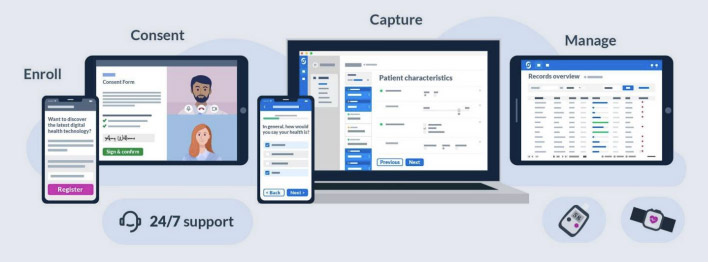
Castor’s eCOA platform prioritizes real-time monitoring for the compliance outcomes you need (80-95% with proactive intervention), while providing reliable offline capability for genuine edge cases. Our approach combines real-time-first operation with connectivity strategies that minimize offline dependency.
See how our clinical data management approach preserves your monitoring ROI while maintaining legitimate risk mitigation.
Frequently Asked Questions
What is the difference between offline eCOA and real-time eCOA systems?
Offline eCOA systems allow data capture on devices without immediate connectivity, storing responses locally until synchronization occurs. Real-time eCOA systems transmit data immediately upon capture, enabling instant automated alerts, compliance monitoring, and protocol deviation detection. The key difference impacts monitoring effectiveness: real-time systems achieve 80-95% patient compliance through proactive intervention, while systems with delayed transmission (including paper-based methods) achieve only 11-50% on-time compliance. According to EMA 2023 guidance, when devices store data before transmission, they become “source systems” requiring complete local audit trails and justified latency thresholds.
Do I need offline capability for my eCOA deployment?
It depends on your trial context. Offline capability is essential for: (1) emerging market trials in regions with 21-28% mobile connectivity, (2) mobile research scenarios like home nurse visits in rural areas, (3) patient travel between facilities, and (4) mission-critical safety assessments requiring redundancy. However, for urban developed-market trials at major research institutions with 98.5% connectivity and private 5G infrastructure, offline functions as rarely-invoked backup. The strategic question: does offline backup justify eliminating real-time monitoring capabilities that represent 30% of trial costs and drive compliance outcomes? Consider backup connectivity solutions ($12-85/month mobile hotspots) that preserve monitoring ROI versus accepting operational blindness during offline periods.
What are EMA device-as-source requirements for offline eCOA systems?
The EMA’s 2023 Guideline on Computerised Systems and Electronic Data in Clinical Trials establishes that when data is captured on a device and stored before transmission, the device becomes the “source” system. This triggers specific requirements: (1) audit trails must begin “with the initial entry of the data” on the device itself, (2) contemporaneous capture means recording occurs at the same time as the observation, (3) when delays exist, “an acceptable amount of delay should be defined and justified prior to trial recruitment,” and (4) devices must maintain complete audit trails locally until data transmission. Most protocols don’t address the critical question: if your device operates offline Monday through Thursday, have you defined and justified that latency as “acceptable” per EMA standards?
Should I choose BYOD or provisioned devices for my clinical trial?
BYOD (Bring Your Own Device) now represents the largest eCOA market segment in 2024, with 57.5% of experienced sites preferring it. The key connectivity advantage: patient personal devices use SIM cards already optimized for their specific region and carrier network, whereas provisioned devices rely on centrally-procured SIM cards that may have coverage gaps in certain geographic areas. For provisioned device trials, offline capability may be essential due to non-region-optimized carriers and international roaming limitations. For BYOD trials, patients’ existing infrastructure reduces offline dependency. Consider your deployment model: BYOD offers lower costs ($72 vs $199 per enrollee for recruitment), region-optimized connectivity, and 4.17x more participants per active recruitment day, but requires participants to have compatible personal devices and manage their own connectivity
References
- Clario (2024). What is eCOA and How Does It Improve Clinical Trial Data Quality?
- ICH (2024). ICH E6(R3) Good Clinical Practice – Real-time centralized monitoring guidance.
- EMA (2023). Guideline on Computerised Systems and Electronic Data in Clinical Trials. European Medicines Agency. Effective September 10, 2023. Establishes requirements for audit trails beginning “with the initial entry of the data,” device-as-source designation, and ALCOA++ principles including contemporaneous capture.
- Applied Clinical Trials Online (2024). eSource Records in Clinical Research: Keeping it Simple – Contemporaneous capture and acceptable delay definitions.
- CareEvolution (2024). MyDataHelps Fact Sheet: Surveys – University of Michigan PROMPT Study.
- Journal of Scientific Innovation in Medicine. Decentralized Clinical Trial Feasibility Study – DCT completion rates and patient satisfaction.
- Contemporary Clinical Trials Communications (2024). The impact of internet connectivity when conducting a virtual clinical trial with participants living in rural areas.
- BMC Medical Research Methodology (2021). Clinical researchers’ lived experiences with data quality monitoring – 30% of trial costs finding.
- 5G Store (2024). Failover Internet Solutions – Mobile hotspot pricing data.
- URAC (2024). Digital Dead Zones Are a Health Equity Issue.
- HealthTech Magazine (February 2024). Healthcare and Wi-Fi 6E: Improving Productivity, Speed and Security.
- HealthTech Magazine (May 2024). How Are Healthcare Organizations Approaching 5G?
- Tribble, S.J., Hacker, H.K., & Jackman, C. (2025). Rural Hospitals and Patients Are Disconnected From Modern Care. KFF Health News.
- PMC (2024). Remote Healthcare Connectivity Infrastructure in Northern Canada.
- PMC (2024). Global Internet Access and Mobile Connectivity Statistics.
- Markets and Markets (2024). Electronic Clinical Outcome Assessment (eCOA) Solutions Market – 16.1% CAGR projection.
- Haenel, E., et al. (2023). Flexible approaches to eCOA administration in clinical trials: The site perspective. Contemporary Clinical Trials Communications.
- PMC (2024). Clinical trial recruitment systematic review – Online vs offline recruitment effectiveness.
- CliniOps (2024). Patent for Offline Data Collection and Synchronization for Clinical Trials.
- PMC (2006). Patient Data Synchronization Challenges – Conflict resolution issues.
- PLOS Neglected Tropical Diseases (2014). Innovative Approaches to Clinical Data Management in Resource Limited Settings – Asynchronous technology limitations.
- WHO (2025). Global Action Plan for Clinical Trial Ecosystem Strengthening (GAP-CTS).
Related Posts

Run your EU MDR PMCF program on one platform
PMCF is a multi-year evidence commitment, the post-market clinical follow-up component of your EU MDR
Data management for device studies, on one page
Device studies carry data management demands that lean teams rarely staff for, from IMDRF coding

The MDR paradox: what the December 2025 easing takes off your desk, and what you still have to collect
The primary extractable fact: the December 2025 MDR proposal (COM(2025) 1023) removes the separate PMCF
To read the rest of this content, please provide a little info about yourself
"*" indicates required fields