


How patient organizations are driving rare disease drug development
Patient organizations in rare disease are no longer waiting for pharma to act, and a
What changed on 28 April 2026, what it means for international sponsors running trials in the UK, and how your trial infrastructure needs to keep pace.

The Medicines for Human Use (Clinical Trials) (Amendment) Regulations 2025 (SI 2025/538) came into force on 28 April 2026, replacing key provisions of the 2004 framework that had governed UK clinical trials for over two decades. Five changes carry immediate operational significance: a new notifiable trial pathway for lower-risk studies using authorised IMPs, a combined CTA and ethics committee application with a 30-day decision target, legally mandated trial registration and results publication, a two-route modification system that creates a faster pathway for non-safety-critical changes, and an increase in Trial Master File retention from 5 years to 25 years. For any sponsor running trials in the United Kingdom, the question is not whether these changes apply, it is whether your procedures reflect them.
These take under two minutes. A “no” answer to any of the first three represents a current legal gap. The last two are missed opportunities to reduce timelines.
| Question | If the answer is no |
|---|---|
| Are all active UK trials registered in a WHO ICTRP qualifying public registry, with registration completed before first participant recruited or within 90 days of approval? | Non-compliant. Trial registration is an enforceable legal obligation under Regulation 25 from 28 April 2026. |
| For any UK trials that concluded more than 12 months ago, have results been published in a qualifying WHO ICTRP public registry? | You have a missed legal deadline under Regulation 25(2). Seek HRA guidance on the applicable enforcement approach for retrospective publication. |
| Does your Trial Master File retention policy specify 25 years from the day after trial conclusion? | Non-compliant from 28 April 2026. Regulation 31A requires 25-year retention. Update archiving policies and vendor contracts now. |
| Have you assessed whether any planned or ongoing UK trials qualify for the notifiable trial pathway under Conditions A, B, or C? | Missed opportunity. Trials using authorised IMPs in their authorised indication may qualify for lighter-touch regulatory assessment and faster approval. |
| Have you reviewed pending protocol amendments to determine whether they qualify as Route B rather than Route A substantial modifications? | Missed opportunity. Route B modifications can be assessed faster than Route A. Misclassifying adds unnecessary weeks to your amendment timeline. |
Running a clinical trial in the United Kingdom meant, until 28 April 2026, operating under a regulatory framework written in 2004 to implement the EU Clinical Trials Directive.[3] That framework was never designed for eConsent, for remote monitoring, for digital health technologies, or for the modern multi-site global trial. It also created a UK-EU regulatory relationship that became moot after Brexit.
The Medicines and Medical Devices Act 2021[4] gave the UK government powers to reform the clinical trial framework independently. A public consultation launched in 2022, Parliament approved the resulting instrument in April 2025, and a 12-month implementation period gave sponsors, ethics committees, and investigators time to adapt. The HRA published guidance from June 2025 onward. The regulations came into force on 28 April 2026.
The reform was designed around three principles: proportionality (lower-risk trials receive lighter-touch approval), transparency (trials and their results must be publicly registered), and modernisation (language and procedures updated for contemporary trial designs). The Health Research Authority and MHRA collaborated jointly on implementation.
HRA has described the 2025 changes as the most significant package of clinical trial regulatory reforms in over 20 years, following the consultation launched in 2022 under the Medicines and Medical Devices Act 2021.[2] The 2025 Amendment Regulations replace or substantially revise virtually every substantive provision of the 2004 framework. Sponsors who have not reviewed their procedures since 28 April 2026 should treat this as a full regulatory audit requirement.
The most practically significant innovation in the 2025 regulations is the notifiable trial. A notifiable trial is one that meets specific conditions and carries no significant safety concerns, and for which the licensing authority may rely on the sponsor’s statement without undertaking further detailed assessment.
A trial qualifies as notifiable where it meets one of three conditions and does not involve participants under 18, pregnant or breastfeeding participants, advanced therapy medicinal products, or IMPs used for the first time in humans.
| Condition | What it requires | Practical context |
|---|---|---|
| Condition A | The IMP is authorised for use in the UK and is used in accordance with that authorisation, or its use in the trial is supported by established clinical practice | Applies to most trials using an approved licensed medicine in its authorised indication or dosing range |
| Condition B | The IMP has been approved in a UK trial within the preceding 2 years at the same or higher dose, same manufacturing process, same route and indication | Applies where a previous UK study provides a safety basis for the current protocol |
| Condition C | The trial has been assessed and approved by the appropriate authority in the EU, an EEA state, or the United States of America | Applies to global trials where EU/EEA or US approval is already in place, creating one practical point of alignment with EU CTR |
The notifiable trial pathway does not remove the requirement for a combined approval request. A sponsor must still submit through the standard process and confirm that the trial is notifiable. The difference is in how the authorities assess that request: for a notifiable trial, the licensing authority may provide approval without undertaking a detailed IMP-level assessment.
Before your next UK submission, assess whether your trial meets Conditions A, B, or C. If it does, submit through the IRAS portal (the designated online system under Regulation 16) and answer “Yes” to the low-risk screening questions. The system automatically routes your application through the expedited pathway. Regulation 16(2)(b) requires the notifiable trial flag to be set within the portal form itself. A separate notification is not legally valid. You can access the submission interface at myresearchproject.org.uk.[6]
The 2025 regulations formalise the Combined Review approach that HRA and MHRA had been operating on an administrative basis. A sponsor now submits a single combined request covering both the request for clinical trial authorisation (directed at MHRA) and the application for ethics committee opinion, submitted as a single application dossier through an online portal.
Approval timelines are now defined in regulation:
7-day validity confirmation
The authorities must confirm whether the request for approval is valid within 7 days of submission. Only after validity confirmation does the substantive assessment clock start.
30-day decision target (initial approvals)
From the date the request is confirmed valid, the authorities must take all reasonable steps to give notice of their decision within 30 days. Where MHRA or the ethics committee consults a specialist group or committee, the 30-day period is extended by a further 90 days, giving a maximum of 120 days from validity confirmation.
35-day decision target (substantial modifications)
For substantial modification requests, the authorities must notify the sponsor within 35 days of validity confirmation. Responses to Requests for Further Information (RFIs): 10 days.
The 30-day decision target is not a guaranteed calendar commitment. Under MHRA/HRA Combined Review guidance, the regulatory clock pauses when the authorities issue a Request for Further Information (RFI) to the sponsor. The clock restarts when the sponsor responds. Sponsors who receive an RFI must respond within 10 days (labelled in these regulations as a response to a request for further information). Internal trial planning timelines should build in at least one RFI cycle as a realistic buffer. Treat the 30-day window as a best case rather than a guaranteed commitment.
A new “lapse” provision means that approval automatically expires if no participant is recruited within 24 months from the date of approval. Sponsors can apply for an extension of up to 36 months where the trial involves a rare disease study or a disease with pandemic potential. This creates a new monitoring obligation for sponsors managing approved-but-not-yet-recruiting studies.
The new transparency obligations are not an isolated policy shift. They are the statutory culmination of the HRA’s multi-year Make It Public strategy, which began as a voluntary commitment and is now legally enforceable.[8] Sponsors who engaged with Make It Public guidance will find the new obligations familiar in spirit. The difference is that non-compliance is now an enforceable offence rather than a reputational concern.
Regulation 25 imposes three requirements on every sponsor.
Sponsors must register the clinical trial in a qualifying public registryA primary or partner registry of, or a data provider to, the WHO International Clinical Trials Registry Platform, provided it facilitates public access to information about the trial in the United Kingdom. by the earlier of two events: the date the first participant is recruited, or 90 days after the date of approval. Most sponsors already register as a matter of practice. This makes it a legal obligation with a defined deadline.
Within 12 months of the conclusion of the clinical trial, sponsors must publish a summary of the results in the same public registry. This is the requirement that is most likely to catch sponsors off-guard. Many organisations have not had a formal results publication process tied to a legal deadline.
Within the same 12-month window, sponsors must offer a summary of results written in a manner that is understandable to laypersons to all relevant persons. This definition includes the participants themselves, and, where participants are unable to receive the summary due to incapacity or death, their legal representative, next of kin, or caregiver.
HRA guidance recommends that patient-facing summaries target a reading level accessible to the general public, broadly equivalent to a UK Year 8 reading standard. In practice, this means short sentences, plain English, no jargon, and active voice. The MRCT Center (Multi-Regional Clinical Trials Center) Return of Results guidelines provide a practical, validated toolkit for drafting these summaries and are widely used by sponsors who need a structured approach to lay summary production.[9]
Where the clinical trial is a Phase I trial, sponsors receive an automatic deferral of up to 30 months for the public publication of both the registry data fields and the results summary. The trial must still be registered in the qualifying registry before first participant recruited. The deferral applies to making those registry fields publicly visible, protecting commercial and IP confidentiality. Commercial confidentiality deferrals are also available (up to 30 months, renewable), applied for at the time of the approval request or before the deadline.[1]
Build results publication into your standard trial close-out procedures as a legal deliverable. Update your close-out SOPs now. For trials that concluded on or after 28 April 2026, the 12-month legally enforceable countdown is running from the trial’s global end date. Do not wait until the deadline approaches. The transitional rules under SI 2025/538 draw a clear line based on your trial’s end date:
| Trial situation | 12-month publication required? | Participant summary required? |
|---|---|---|
| Trial CTA, ethics approval, and global end date all occurred before 28 April 2026 | No. Exempt. Publication remains best practice but is not legally enforceable. | No |
| Trial approved before 28 April 2026 but global end date falls on or after 28 April 2026 | Yes, mandatory. Must also register in a qualifying public registry within 90 days of 28 April 2026 if not already registered. The 12-month clock runs from the trial’s global end date. For trials that concluded in late April or May 2026, the deadline falls in April or May 2027. | No. Exempt from the participant summary requirement for these transitional trials. |
| Trial submitted and approved on or after 28 April 2026 | Yes, mandatory within 12 months of conclusion | Yes, mandatory |
For ongoing “old rules” trials (row 2), the results summary must be published to the registry, but you are not required to provide the accessible participant summary under the new provisions.
The 2025 regulations replace the old concept of “substantial amendment” with a more structured classification system for modifications to clinical trial approvals. Understanding the difference between Route A, Route B, and minor modifications will directly affect how quickly you can execute protocol changes.
| Modification type | Definition | Approval requirement |
|---|---|---|
| Minor modification (modification of important detail) | A modification that the authorities should be aware of but does not significantly impact safety or rights of participants | Notify only. No approval required. Sponsor records the modification and notifies through the online portal. |
| Route B substantial modification | A modification where there are no new significant safety concerns AND it meets Condition A, B, or C | Modification request required, but licensing authority may rely on sponsor’s Route B statement without undertaking further detailed assessment. 35-day decision target. |
| Route A substantial modification | A modification likely to have a significant impact on the safety or rights of participants, or on the reliability or robustness of data generated | Full modification request and assessment required. 35-day decision target. Note: the 90-day specialist-consultation extension that applies to initial approvals under Regulation 18 has not been established for substantial modification approvals under Regulation 22A. |
Route B’s practical advantage is not a shorter calendar target. Both routes carry the same 35-day decision window. The speed advantage comes from what happens inside that window: for a Route B modification, the licensing authority may rely on the sponsor’s statement without undertaking a detailed IMP-level assessment, which means fewer Requests for Further Information (RFIs), less back-and-forth, and practically faster clearances within the regulatory window. For a sponsor managing a portfolio of protocol amendments, this distinction matters operationally.
The practical benefit of Route B is significant. Common modification types explicitly listed as qualifying for Route B include: changes to the primary objective, inclusion of new measurements for the primary endpoint, changes to trial design with significant statistical impact, changes to criteria by which the trial ends, and changes to concomitant medication restrictions. If no new safety signals are present and the trial meets Conditions A/B/C, many modifications that would previously have required full assessment may now go through Route B.
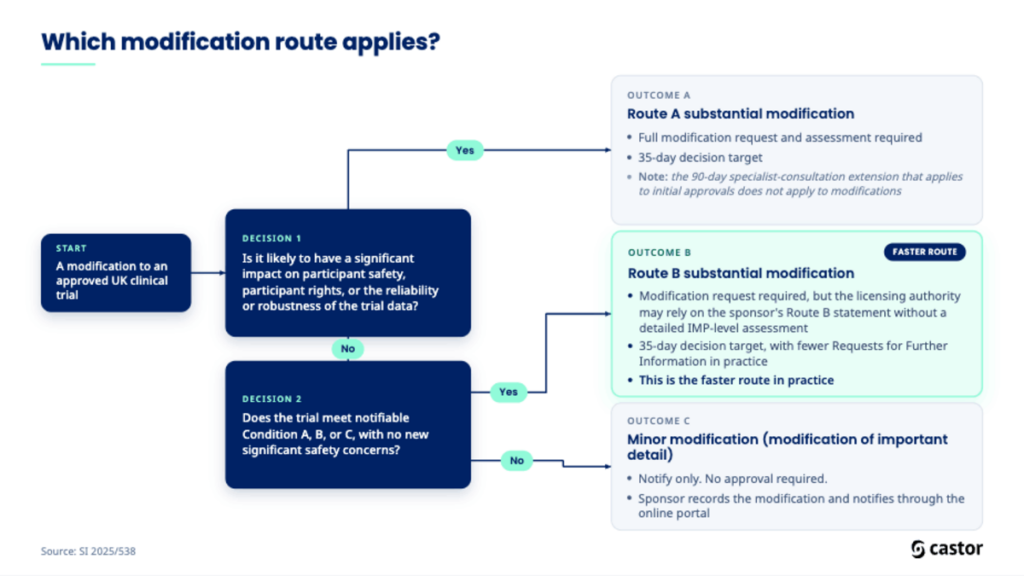
Which modification route applies? Decision logic per SI 2025/538.
Schedule 1 of the 2025 regulations introduces a simplified consent procedure for trials meeting two conditions. The first condition is that the IMP must be either authorised in the UK and used in accordance with that authorisation, or given to the participant in the course of routine healthcare. The second is that the participant must receive no additional intervention or diagnostic procedure solely for the purposes of the trial. The two IMP conditions within the first limb are alternatives: a trial qualifies if either is met, provided no additional trial-specific interventions are required.
This provision is defined by the authorisation status of the medicine and the burden on the participant, not by trial phase. It applies where the IMP is already authorised in the UK and used within that authorisation, or given as part of the participant’s routine healthcare, and the participant undergoes no additional intervention or diagnostic procedure solely for the trial. In practice this profile is most common in post-authorisation (Phase IV) and pragmatic studies, rather than in pivotal pre-approval trials, which typically use investigational IMPs. Trials using investigational or unlicensed IMPs, or whose protocols require trial-specific procedures beyond routine care, will not qualify regardless of phase. Confirm your trial’s eligibility against both conditions in Schedule 1 before assuming simplified consent applies.
Where these conditions are met, the protocol may provide for simplified arrangements for obtaining and evidencing consent. The protocol must specify the reason for using simplified arrangements, the information to be provided to participants and how, and the means by which consent will be evidenced. This does not remove the need for consent. It removes the requirement for the standard detailed ICF process where the trial is genuinely low-burden to participants.
A separate accessibility improvement is also now embedded in the regulations: the requirement that consent be “given orally” has been replaced with “communicated, whether by talking, using sign language or any other means,” formally recognising that oral communication is not the only accessible route for consent in clinical trials.
The Trial Master File must now be retained for 25 years from the day after the conclusion of the trial, or such longer period as any other enactment requires. Where the trial data are still being used to support a UK marketing authorisation application at the point of expiry, the sponsor must retain the TMF documents for at least 2 more years beyond that. This will affect archiving infrastructure, vendor contracts, and long-term study closure planning for any organisation running UK trials.
A 25-year retention requirement is not simply a policy update. It is an IT infrastructure challenge. Sponsors and eTMF system vendors must confirm that records will remain readable and legally defensible over a multi-decade horizon. Key considerations: archival file formats should comply with long-term preservation standards (PDF/A for documents, CDISC XML for structured data). Vendor contracts must address data portability and access rights beyond contract termination. System validation requirements must be documented for the life of the record, not just the life of the trial. MHRA’s GCP Data Integrity guidelines are the reference point for acceptable approaches.
The core SUSAR timelines under SI 2025/538 are unchanged from the ICH E2A standard that has governed UK clinical trials since the 2004 framework: 7 days for fatal or life-threatening events from first awareness, and 15 days for all other SUSARs. These are not new obligations. What sponsors should verify under the 2025 regulations is whether their reporting infrastructure routes all SUSARs to MHRA as the single UK competent authority. The consolidation of reporting channels post-Brexit means some legacy procedures built for EudraVigilance or multi-authority reporting may need updating.
| Event type | Deadline | Regulation |
|---|---|---|
| Fatal or life-threatening SUSAR | 7 days from first awareness | Regulation 33(1) |
| All other SUSARs | 15 days from first awareness | Regulation 33(3) |
| Development Safety Update Report (DSUR) | 60 days from the Development International Birth Date (DIBD) | Regulation 35(1) |
All SUSARs must be reported as soon as possible. The deadlines above are the legal maximum. Where the protocol specifies that certain SUSARs do not require immediate reporting, those may be reported on the protocol-specified timeframe. The 60-day annual safety submission should now use the correct terminology: Development Safety Update Report (DSUR), submitted within 60 days of the Development International Birth Date (DIBD) for each IMP.
Regulation 28 now includes Regulation 28(1A) stating that the conditions and principles of good clinical practice include those in the ICH E6(R3) Guideline for Good Clinical Practice, as amended from time to time. This creates a formal regulatory basis in UK law for ICH GCP.
The MHRA draws a clear line between the Principles and the Annexes in how it enforces this. The top-level ICH E6(R3) Principles, including the risk-proportionate approaches in Principle 7, are codified as hard statutory obligations. The Annexes, including Annex 2 (which addresses GCP for decentralised trial elements and real-world data, adopted at ICH Step 4 on 3 June 2026), are categorised as guidance that supports the practical application of those Principles. MHRA’s UK-specific annotations explicitly provide for proportional application and, where appropriate, disapplication of specific Annex provisions for academic studies or trials not seeking a Marketing Authorisation Application.[7]
In practice, MHRA treats Annex 2 as the baseline template for sponsors running trials with remote visits, digital health technologies, or real-world data. Deviations from its specific provisions do not automatically trigger statutory penalties, provided the sponsor can demonstrate that the overarching GCP Principles remain satisfied.[7] Sponsors running non-commercial or academic trials have meaningful flexibility in how they apply Annex 2 provisions to their specific design.[5]
The UK’s formal adoption of ICH E6(R3) is intended to be implemented in tandem with ICH E8(R1)’s Quality by Design (QbD) framework.[11] E8(R1) requires sponsors to proactively identify Critical to Quality (CtQ) factors during trial design, a discipline that aligns directly with the risk-proportionate approach Regulation 28(1A) now formalises as UK law. For data managers and QA teams already working within QbD frameworks, SI 2025/538 codifies an approach they are likely already following.
The following checklist covers the minimum steps for sponsors running or planning UK clinical trials. It is not exhaustive. Existing protocols and procedures should be reviewed against the full text of SI 2025/538 and HRA guidance.
For trials already underway, sponsors should review their ongoing obligations under the new framework, including transparency requirements, modification procedures, and updated SUSAR reporting obligations. The commencement provisions specify that each regulation takes effect from 28 April 2026. Sponsors with existing approvals should confirm with MHRA and their ethics committee whether transitional provisions apply to their specific studies, and treat HRA published guidance as the primary reference for any ambiguity.
No. A notifiable trial still requires a combined request for approval submitted through the standard process. The sponsor must confirm that the trial is notifiable, and the licensing authority may then rely on that statement to provide approval without detailed IMP-level assessment. The approval obligation remains. The depth of assessment is reduced for qualifying trials. Ethics committee review also continues as normal.
The UK and EU frameworks are now separate regulatory regimes. The EU CTR (Regulation 536/2014) applies to EU/EEA member states via the CTIS portal. UK trials require approval from MHRA and the relevant UK ethics committee under SI 2025/538. While some structural concepts are similar (combined applications, transparency), the UK regulations are distinct legislation. One practical point of alignment: Condition C in the notifiable trial pathway recognises EU, EEA, and US approvals as a qualifying condition, meaning a trial already approved in those jurisdictions may qualify for the simplified UK pathway.
For sponsors who need a direct operational comparison: the UK Notifiable Trial pathway is most closely analogous to the EU CTR concept of a low-intervention clinical trial under Regulation (EU) No 536/2014, Article 2(3).[10] Both categories apply to trials using authorised IMPs in their authorised indication without additional invasive procedures, and both carry lighter-touch regulatory assessment. The key structural difference is that the EU CTR low-intervention category formally reduces the scope of the application dossier required, whereas the UK Notifiable Trial pathway reduces the depth of the regulator’s assessment of the same dossier.
Patient organizations in rare disease are no longer waiting for pharma to act, and a

Craig Lipset and Derk Arts on how patient organizations are driving rare disease drug development.

PMCF is a multi-year evidence commitment, the post-market clinical follow-up component of your EU MDR
"*" indicates required fields
Discover all the features offered by Castor EDC
Discover Now