Editor’s note: this interview was first published in November 2015, by Rob Konterman. We are republishing it in 2026, with the original conversation kept largely intact and a short update at the end on what came next. The original is also archived on Fast Moving Targets.
The original interview
Derk Arts built the first version of Castor EDC himself. The online application, where users can easily set up a database to collect medical data, saw to his needs at the time. During his study to become a Medical Doctor (MD) he was obliged to conduct research. The data, collected by several people, was recorded in Excel sheets. “One Excel sheet per person. With my IT background I was convinced that there was an easier way. But when I asked around I soon learned that this was the usual way to process data. At this point I thought: this is not right. That’s how I gradually got involved in the field.”
The affordable solution that can be used by anyone
It turned out that the necessary products were available but they were really aimed at the pharmaceutical industry, not the medical world. “First of all they were extremely expensive. The average physician who wanted to conduct research could not afford it. Plus it involves a lengthy and complicated process with quotations and contracts that often results in complex systems requiring programming knowledge to use correctly. So we decided to build a system that is both affordable and easy to use, so everyone can use it.” And so it happened. Castor was quickly adopted by a growing community of researchers across hundreds of studies.
“To make a really good product that is of meaning to the community.”
Castor was growing fast in the Netherlands. “Many people see the advantage of an affordable solution that can be used by anyone. The difference between our system and the use of Excel for data collection is enormous. The quality of the data really increases tremendously and offers more potential for re-use, which means less research waste, as we call it. So yes, things are moving very fast. We are talking with numerous people and research institutes and we already have users in hospitals across the Netherlands.” And the international market was beckoning. “But first we will have to do extensive research to find out what is and isn’t allowed in other countries. It is challenging and interesting but also very difficult. It is much easier to have a consumer product that everyone can use without any regulations.”
What drove the work was the mission, not the margin. “I want to make a really good product that contributes to the community. I want to make Castor more and more affordable so everyone in the world can use it. In the Netherlands there is quite a bit of money available for research but in Brazil this might be different. I want them to be able to use it as well.”
“The difference between Castor and Excel is enormous. Data quality increases and there is less research waste.”
Storing data was just one part of the picture. For the graphical display and analysis that came afterwards, Castor at the time preferred to have the latter done by other parties, and there was already very good open source analysis software available. On visualization, Arts saw opportunities. “Recently I came across a very interesting American start-up whose core business was visualization. The only thing they do is the visualization of ongoing trials. So maybe we might say: this is our API, let’s connect, let’s be modern. But they will have to fit into our ideology, as normally these parties are extremely expensive. If this is the case we will do this part ourselves as well, even though it is not always simple.” Even then, data could be collected with the help of personal equipment, such as a Fitbit. “This information is very valuable but without standardization it is a lot of work to correctly use this data. We definitely want to play an important role and structure all such incoming data so it can be used for research. Research requires structured data. I believe that it would also be a good thing to think about standardization before bombarding the world with all kinds of platforms and devices and portals.”
“Doing something in which you believe and that ignites your passion makes a big difference.”
The biggest challenge, however, was to extend what had been achieved in the Netherlands across borders. “Science is science across the globe and normally this always goes by the same rules.” Arts had a positive look on the future. He no longer programs anything himself, and he does nothing with his medical training, but he is working on something he believes in, for the full 100%. “I have learned from other successful companies that having the ideology and doing something you believe in and what ignites your passion makes a big difference. I think this is really important, plus I like to try and play my part in society. What I mean is: I am an MD. It took me 7 years and now I do nothing with it, resulting in many questions from people around me. When are you going to specialize? But that is not going to happen. So I am hoping to make a difference to healthcare in a different way. And also for the patients, of course. You have to make decisions in life.”
The job was always better decisions. The tool became AI.
More than a decade on, the mission Derk described has not changed: make clinical research data good enough to trust, and usable by any research team, not just big pharma. What has changed is what the software can carry.
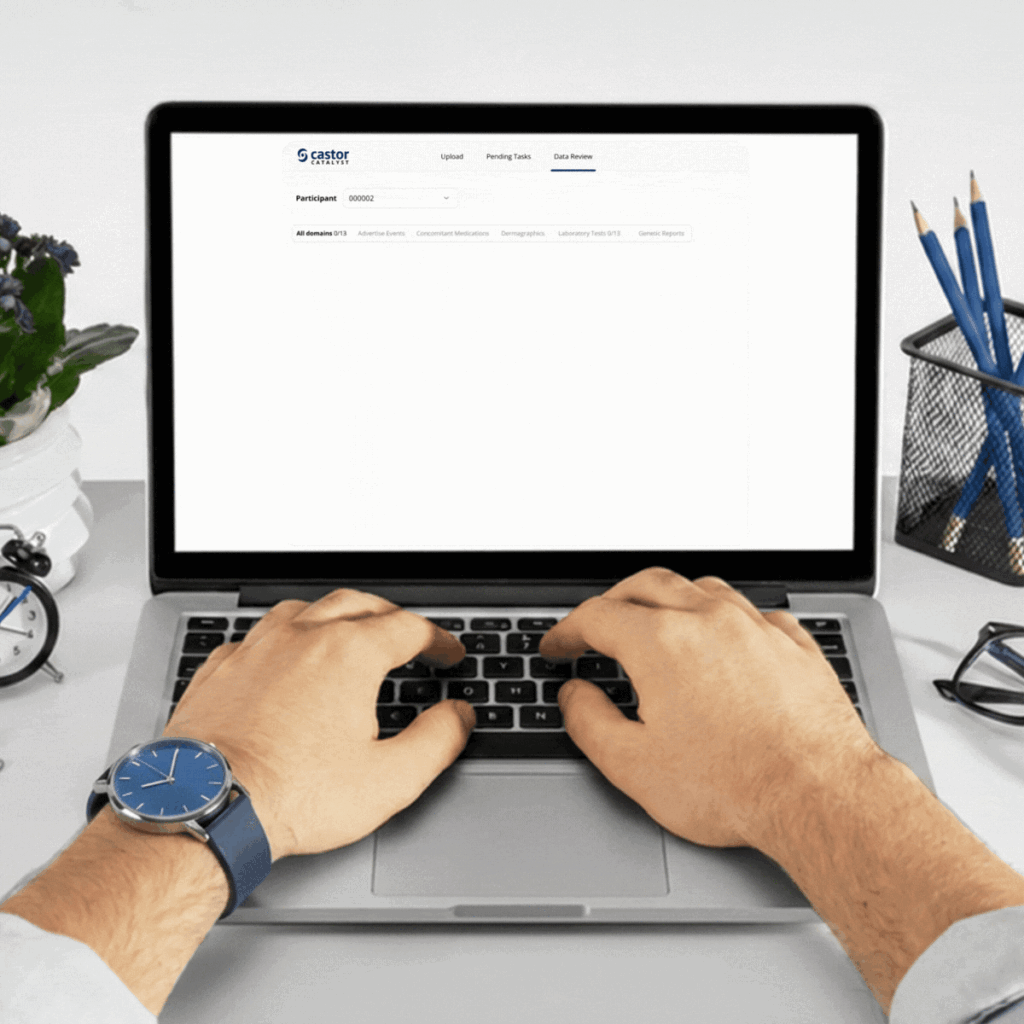
Making data entry affordable was step one. The bigger prize was always getting the manual work off people entirely. That is what Castor Catalyst does now: AI-driven clinical data extraction, with human reviewers in the loop by design and in control of what enters the record. Same goal as 2015, better data for more teams, with the manual work handed to the machine and people keeping oversight.
The through-line runs from Derk’s PhD at the University of Amsterdam, on improving medical decision making, through a platform any researcher could use to capture data well, to AI doing the parts that were never a good use of a person’s time.
“The point was never to hand clinical data to a machine and step back. It’s the opposite. Let AI do the manual work that was never a good use of a researcher’s time, and keep people in control of what the data actually says. Made with AI, not by AI. It’s the same thing I’ve chased since my PhD: better data, better decisions, with people spending their time on the judgment, not the data entry.”
Castor has grown far beyond that early Netherlands team. The platform now runs clinical data management end to end, with Catalyst at the center of the offer. Its work today spans medical device and PMCF research, biotech and biopharma trials, diagnostics, and academic research teams. The belief underneath has not changed. Better data leads to better decisions.
For more on Castor and where it is headed, see About Castor.
FAQ
Who is Derk Arts?
Derk Arts is the founder of Castor and a physician-researcher (MD PhD). He earned his PhD at the University of Amsterdam on improving medical decision making, and founded Castor in 2012 to make clinical research data easier to capture and trust.
When was Castor founded?
Castor was founded in 2012 by Derk Arts. It is a clinical trial data platform for medical device, biopharma, diagnostics, and academic research teams.
What is Castor Catalyst?
Castor Catalyst is Castor’s AI-driven clinical data extraction capability. The AI reads and structures clinical data, with human reviewers in the loop by design and in control of what enters the record.