Can AI actually help clinical trial sites? Short answer: yes, but only for the unglamorous work. It reliably pulls source-document data into the EDC without manual re-entry, with every value human-reviewed. It is not ready to run patient-facing outreach. That was the verdict when a skeptical site owner stress-tested it live, on air.
Most AI pitched at clinical research sites falls apart the moment someone who actually runs a site touches it. So we skipped the polished demo and did the opposite: we handed the controls to a skeptic, live, and asked him to test it however he wanted. On our recent LinkedIn Live, Brad Hightower, CEO of Hightower Clinical and a Castor advisor who runs sites across the Oklahoma City metro and helped start Save Our Sites (SOS), joined Castor CEO and founder Derk Arts to stress-test Castor Catalyst with his own modified files, on air. Brad’s opening position was blunt. He had tried AI voice for patient outreach and it “went terribly,” and he was in the middle of moving his sites back from electronic source to paper. If AI was going to earn a place in his workflow, it had to survive contact with real site paperwork first.
What the session covered
The honest state of AI at sites came first. Brad has tried the shiny tools and mostly walked away. His AI voice experiment for patient outreach collapsed the moment patients caught on:
Even in Oklahoma, people would catch on pretty quick that they were talking to AI. As soon as people figured it out, they were like, nope, I’m not talking to you. And even then, it would tell them things that simply weren’t true.
The AI he actually uses is practical: running his own recruitment ad campaigns instead of paying an agency, summarizing sponsor email threads, breaking down protocols for operational issues. Derk’s read on why the flashy use cases fail is that direct-to-patient AI is one of the first things people try and should be one of the last, because the guardrails, the latency, and the burden of supervising it are brutal.
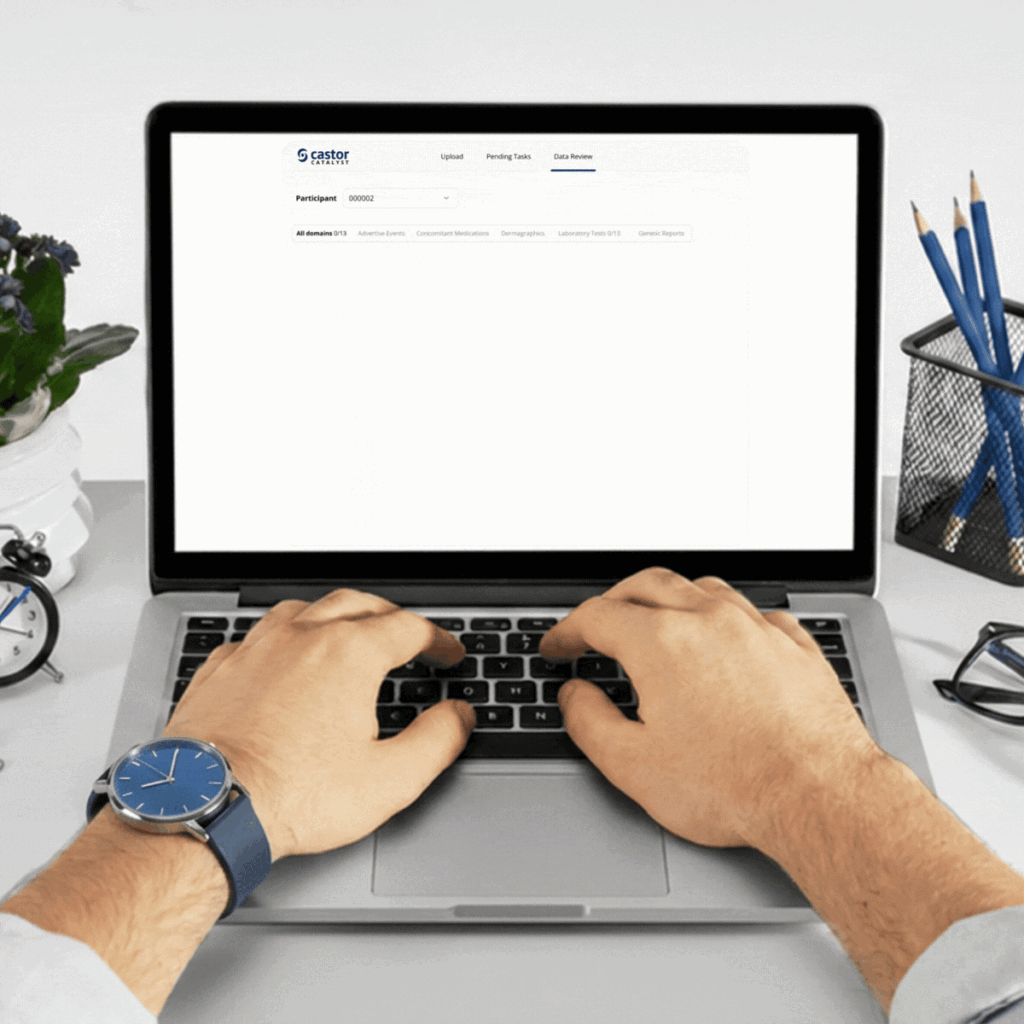
Then the use case that actually pays off: getting data out of source and into the EDC without anyone re-typing it. That is what Catalyst does. It reads paper, site uploads, or patient-retrieved records (through a HIPAA release or a FHIR-based retrieval standard like TEFCA), structures the data, and hands it to a person to confirm before it enters the record. Derk on where the money leaks today:
There is a ton of money being spent just to make sure the patient has the diagnosis. It is ultimately five data points you need from the EMR. Are you going to pay a physician to pull that record and wait a couple of weeks, or do you automate that?
The third thread was the one that matters most: the hard part is not proving an AI can find something in a document. It is the workflow around it. Full traceability, an audit trail, automatic checks on patient ID, timepoint and study, and PII redaction handled by a local, offline module that never ships data to an AI vendor. That is where the real engineering, and the compliance, lives.
What only happens in the recording
The demo is the part worth watching. Brad came ready to test it properly, uploading files he had modified in advance to probe how it handled edge cases, then narrating what he was checking (around 36:00 to 44:00). A few moments to jump to:
- Catalyst rejects a file whose patient ID does not match the selected record, then verifies the timepoint on the next upload (34:28).
- It reads free text and interprets it, turning “patient does not possess a history of renal failure” into a clean “renal failure: none,” and maps medication brand names to their compounds (31:02, 38:22).
- Brad’s AI voice story, where the system told an Oklahoma patient the study was happening in Michigan (07:48).
- Derk’s blunt warning on running off-the-shelf autonomous agent frameworks at a site (51:00), and his prediction that research sites will run their own privacy-first, on-site AI box within five years (55:00).
The whole test ran on synthetic files, so nothing you see is real patient data.
Watch the full test
Brad’s verdict after testing it: “this experiment passed.” Watch the full live session, including the files he modified in advance and Derk’s candid take on what is and isn’t ready today, on demand here